
Piping Systems : free online Process Engineering Handbook
Process Engineer's Tools has selected here all the key knowledge Engineers working with fluid flow / fluid dynamics need to solve industrial problems or simply get a handy reminder when required. Bookmark the page for future reference !

PIPING SYSTEMS
Discover pipe pressure drop principles and access free Excel calculation tools for process engineers. Calculate pressure drop in straight pipes, factor in bends, valves, and more for comprehensive results.

Essential information on the equivalent length of common valves and fittings in piping systems, facilitating pressure drop calculations. It's a valuable resource for engineers and professionals looking to streamline preliminary studies or troubleshooting. Visit the page for detailed tables and data in both US and SI units to enhance your piping system design and analysis
Recommended K coefficient, which is used to calculate pressure drop in fluid piping due to fittings and valves in turbulent flow. It offers a range of K coefficients for various common valves and fittings, aiding engineers in precise pressure drop calculations. These coefficients are essential for ensuring efficient and accurate design of fluid piping systems.
References for laminar flow pressure drop calculations in fluid piping systems.Recommended K coefficients for pressure drop in valves and fittings in LAMINAR flow, offering two approaches. Kittredge and Rowley's data provides frictional loss coefficients for various Reynolds numbers, while Hooper's method offers an approximate approach by using coefficients for turbulent flow and laminar flow adjustments.
This webpage explains how to determine if a pipe is partially full, which is crucial for accurate calculations in scenarios like return pipes and condensate systems. An Excel calculator is proposed at the end of the article.
This article offers insights into gas sonic velocity and critical pressure ratios, along with a downloadable Excel calculator for sonic velocity estimation. Sonic velocity represents the maximum attainable gas speed within a system, impacting aspects like pressure safety valves and flow constraints. Formula in both metric and imperial units are given.
Overview of control valve types
commonly used in process industries, including globe valves, angle
valves, butterfly valves, gate valves, and ball valves. Each valve
type is briefly described, highlighting their specific design
features and typical flow parameters. We also give manufacturers
references for each valve type and give links to additional pages
for valve sizing calculations.
-
Valves Cv and sizing for liquid and gas
Control valve sizing, with a focus on
flow coefficients Cv and Kv, for both liquids and gases. It
explains the definitions of these coefficients and their
conversions. The calculations for flow through valves, considering
subcritical and critical flow conditions, are detailed for both
liquids and gases in SI units. The page also provides guidance on
control valve sizing, emphasizing maintaining a specific pressure
drop ratio and flow range. Corrections for special cases, such as
pipe reducers, viscosity, and laminar flow, are discussed.
-
Valves Cv and sizing for steam and superheated steam
Control valve sizing and flow
calculations, with a focus on defining Cv and Kv. The page
provides formulas for calculating mass flow rates of steam and
superheated steam in both SI and US units. Additionally, it offers
guidelines for optimal control valve sizing practices to ensure
efficient performance.
The webpage explains Cv and Kv
definitions for valve flow in SI units. It also explain how to
calculate the required Cv for valves in two-phase flow conditions,
considering factors like mass flow, geometry, and pressure drops,
aiding effective valve selection.
This article covers valve Cv
calculation for laminar flow conditions. It explains how to
correct Cv for such situations and provides detailed steps,
including calculations for factors like Reynolds number and
correction factor. You can use this resource to select the right
valve for laminar flow applications, ensuring precise control and
minimizing pressure drop.
Information on valve flow
characteristics, offering insights on different types such as
linear, exponential, semi-quick opening, and quick opening. The
article emphasizes the importance of selecting the right valve for
precise control and the factors affecting valve behavior within a
circuit. Valve gain and actuator torque considerations for optimal
performance are also discussed.
Top 5 Most
Popular
1. Compressor
Power Calculation
2. Pump Power Calculation
3. Pipe Pressure
Drop Calculation
4. Fluid Velocity in pipes
5. Churchill Correlation (friction
factor)
This guide provides insights into
pressure relief valve design and sizing, focusing on API 520
standards. It explains critical vs. subcritical flows and offers
formulas for safety valve sizing, especially for steam
applications. Engineers can select standard valve orifice sizes
based on standardized designations.
This guide explains pressure relief
valve design and sizing for low-pressure safety venting. It
outlines theoretical formulas and coefficients for calculating
valve flow. Note that this information is for low-pressure gas
applications only.
This guide explains pressure relief
valve design and sizing for liquid flow, emphasizing safety. It
provides formulas and coefficients for calculating valve
requirements based on API520 standards.
All about hydrostatic pressure – the force exerted by resting fluid due to gravity : calculation formula of hydrostatic pressure, table for pressure vs. water depth and practice problems. Access the Hydrostatic Pressure calculator in Excel.
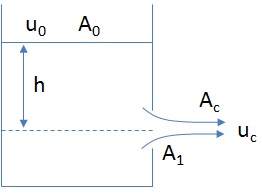
Understand Torricelli's Law for tank orifice flowrate. Calculation of liquid flowrate with the Torricelli formula, with worked examples. Calculation of the time to empty a tank using Torricelli's equation, with worked example.
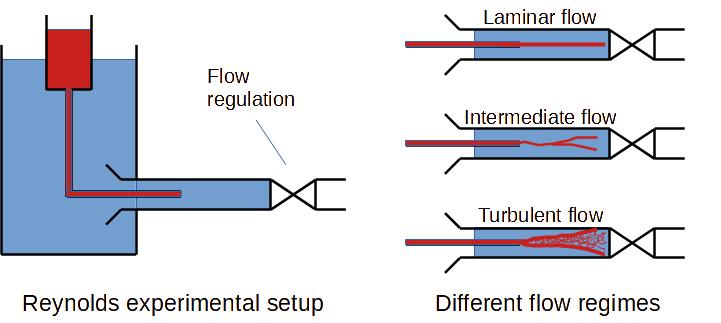
Calculation of Reynolds number
The hydraulic diameter concept
simplifies non-circular flow calculations. It is useful for
Reynolds number and flow regimes (laminar, intermediary,
turbulent). Access an Excel Calculator for hydraulic diameter.
Learn about the friction factor in
pipes and how to calculate it. Understand its significance in
fluid flow and explore formulas for laminar and turbulent regimes,
including the Hagen-Poiseuille equation.
Discover the difference between Fanning
and Moody friction factors in pipe flow. Learn how to calculate
them and their significance in understanding fluid-pipe
interactions. Explore correlations and the Moody diagram for
practical insights.
This page explains what is the
Colebrook equation, a valuable tool in fluid mechanics, relating
it to Reynolds number and pipe wall roughness. Get the calculation
formula and understand its significance in estimating pressure
drop and explore alternatives like the Darcy-Weisbach and
Hazen-Williams equations.
You can calculate friction factors for
various flow regimes using the Churchill equation. Easily estimate
pressure drops in pipes from laminar to turbulent flows. Download
our free Excel calculation tool for Churchill correlation to
simplify your calculations and streamline your work.
Efficiently calculate pressure drop in
pipes with our handy tools. Understand the principles: it's the
sum of friction along straight pipes and singularities like bends
or valves. Simplify your work with our Excel calculation tools for
both liquid and gas flows.
Understanding fluid velocity in pipes
is crucial for flow characterization and sizing. Calculate it
easily with our Excel tool. Recommended velocities for common
fluids provided. Make informed design decisions for efficient
pressure and cost balance.
The different flow regimes in pipes as a function of Reynolds number
How to size and calculate orifice
plates for precise fluid flow control and measurement. You can
access our Excel calculation tool to practice the concepts
presented in the page
Learn how to calculate motor power for a tank agitator step by
step. Find a free Excel calculator for agitator power requirements.
This article provides a comprehensive guide to flow meter installation and usage, covering selection criteria, installation processes, and type-specific guidelines for various flow meters. It addresses challenges such as high-viscosity fluids, temperature effects, and common metering issues, along with maintenance requirements and application considerations.
Learn about Coriolis mass flowmeters, their advantages, and factors affecting performance. Discover how to select, install, and maintain them for accurate fluid flow measurement in various industries.
Learn about water hammer, a sudden pressure increase in fluid-carrying pipes caused by rapid flow changes. Discover its consequences, the calculation of pressure rise, and prevention methods to safeguard pipes and equipment from damage. Access a an Excel calculator for pressure rise prediction
This page is presenting the importance of recommended velocities in water pipe networks. You can understand why following these guidelines is crucial for energy efficiency and system performance. Calculate water flow velocity with our Excel tool.
This page is explaining step by step how to calculate the time required for a pitch blade agitator to homogenize a liquid mixture.
Learn about terminal velocity in fluid mechanics. Understand how to calculate it for single particles and in the presence of other particles. Check out our Excel calculator for testing the concepts presented in the page.
This page is explaining step by step how to estimate the apparent viscosity of a fluid from the power that is applied to a double helix agitator.
This article is presenting non-Newtonian fluids, where viscosity isn't constant but varies with shear rate. Learn about time-independent and time-dependent non-Newtonian behaviors, and explore the unique properties of viscoelastic materials.
Gain a comprehensive understanding of hoses, their types, and how to calculate pressure losses in fluid transport systems. Explore the diverse materials, designs, and classifications of hoses, from rubber to stainless steel. Learn how factors like length, diameter, flow rate, and fluid viscosity contribute to pressure loss. Follow a step-by-step guide to calculate pressure loss using the Darcy-Weisbach equation. Whether you're dealing with rubber, PVC, or thermoplastic hoses, this guide equips you with essential insights for efficient system design.
Unlock the potential of check valves in piping systems with our comprehensive guide. Explore swing, lift, ball, and diaphragm check valves—understand their design, installation, and troubleshooting. Delve into critical considerations like material selection, sizing, and cracking pressure. Learn to address common issues such as backflow, water hammer, and excessive wear. Our detailed guide ensures you master the intricacies of check valves.
Explore the world of check valves in piping engineering—essential components ensuring fluid flows in a single direction. Discover the diverse designs available and their applications. Uncover the common issue of noisy check valves and learn the importance of proper design to avoid quick wear. Delve into a step-by-step guide for calculating the minimum pipe velocity needed for full disc lift in check valves. Access a practical Excel calculator for quick and accurate calculations.
Explore the crucial role of steam traps in process industries, understand common failure modes, and learn how to calculate steam leakage. Access an Excel calculator for precise steam loss estimations and discover cost-saving strategies.
Explore efficient methods for calculating pressure drop in long gas pipelines. Learn about isothermal, Weymouth, Panhandle equations, and a modified isothermal approach. Access an Excel calculator for gas flow estimations.
Learn essential principles for designing hygienic piping systems in food and pharma industries. This page covers key practices like eliminating dead ends, ensuring smooth surfaces, and selecting proper couplings and valves. Discover how to prevent material accumulation, optimize cleaning efficiency, and maintain product quality. For comprehensive guidance on hygienic piping design, visit the website
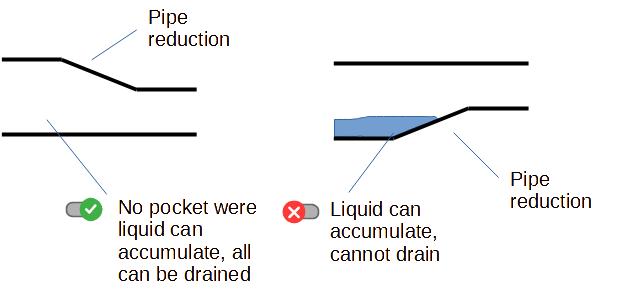
Discover essential principles for effective Cleaning in Place (CIP) systems in food industries. Learn about the 4 Ts: Time, Temperature, Titration, and Turbulence, crucial for thorough cleaning. Understand the sequence of cleaning steps and safety measures. Explore key considerations for hygienic design, including pipe design and dead end prevention.
Comprehensive guide to Cleaning-In-Place (CIP) systems using spray balls in food and beverage production. It covers the working principles, types of spray balls (static, rotating, multi-jet, sanitary), and selection criteria based on tank geometry, soil type, and regulatory requirements. The article provides detailed design parameters, including pressure, flow rates, and material choices, alongside a step-by-step procedure for sizing and placing spray balls. It emphasizes validation, maintenance, and practical considerations for ensuring effective and compliant cleaning performance.
Explore power numbers for various agitator types essential for effective tank agitation. Learn how power numbers facilitate calculating the required shaft power for agitation. Understand the importance of knowing the power number for efficient mixing and troubleshooting. Discover estimated power numbers for common agitator geometries, aiding in preliminary calculations when pilot trials aren't feasible
Discover pumping numbers for common agitators crucial for efficient tank agitation. Learn how to calculate pumping flow and understand its significance in ensuring proper fluid circulation. Find references for pumping numbers to aid in preliminary calculations, especially when pilot trials aren't feasible. Explore agitator types and their associated pumping numbers for effective tank mixing.
This article explains why rheology must be part of everyday process design for non-Newtonian fluids in pipes and equipment. It starts by contrasting Newtonian and non-Newtonian behaviour, showing how shear-dependent viscosity breaks the simple “single viscosity” design approach used for water-like fluids. It then defines shear rate in pipe flow and highlights the trap of using the nominal expression 8V/D, which is only exact for Newtonian laminar flow and underestimates wall shear rate for shear-thinning systems.
The article introduces the Weissenberg–Rabinowitsch–Mooney correction to convert nominal to true wall shear rate and explains how to use the flow behaviour index to obtain realistic apparent viscosities for design. Finally, it links corrected shear rate and rheological data to practical outcomes: pressure drop prediction, pipeline sizing, pump selection, flow regime assessment, and scale-up, emphasising how skipping this step can lead to blockages, unstable operation, and unnecessary cost.