
Friction factor
Question or remark ? Please contact us at contact@myengineeringtools.com
1. Definition of friction factor
2. Calculation of friction factor
3. Hagen-Poiseuille relation
1. Definition of friction factor
The friction factor represents the loss of pressure of a fluid in a pipe due to the shear stress interactions between the fluid and the pipe wall.

\(f/2\) = friction factor - Fanning (dimensionless)
\(D\) = Pipe internal diameter (m)
\(u_m\) = mean fluid velocity (m/s)
\(\Delta P_f\) = pressure drop due to friction (Pa)
\(L\) = length of pipe (m)
\(\rho\) = density of fluid (kg/m³)
Interactive Pipe Friction & Pressure Drop Sizing Tool
Calculation Results
2. Calculation of friction factor
How to find the friction factor of a pipe? The different mathematical equations below allow you to calculate the friction factor of a pipe depending on the fluid flow regime.
Flow Regimes:
- Laminar regime (\(\text{Re} \le 2000\)): The friction factor is independent of pipe roughness and depends only on velocity and viscosity. \[ \frac{f}{2} = \frac{8}{\text{Re}} \]
- Turbulent regime (\(\text{Re} \ge 4000\)): The flow is highly disturbed and friction depends heavily on the relative roughness of the wall.
Turbulent Flow Empirical Correlations:
Blasius Correlation (applicable to smooth pipes only and for \(\text{Re} < 10^5\)):
\[ \frac{f}{2} = 0.023 \cdot \text{Re}^{-0.20} \]Churchill Correlation (applicable for any Reynolds number \(\text{Re}\) and relative roughness ratio \(e/D\). This explicit equation handles laminar, transitional, and turbulent regimes seamlessly):
\[ \frac{f}{2} = \left[ \left( \frac{8}{\text{Re}} \right)^{12} + \frac{1}{(A + B)^{3/2}} \right]^{1/12} \] \[ A = \left\{ 2.457 \ln \left[ \left( \left( \frac{7}{\text{Re}} \right)^{0.9} + 0.27 \frac{e}{D} \right)^{-1} \right] \right\}^{16} \] \[ B = \left( \frac{37530}{\text{Re}} \right)^{16} \]
With \(e\) representing the absolute internal pipe roughness in meters (m).
Another common sizing method is using the graphical Moody Diagram, which is a log-log friction factor chart plotting friction factor as a function of the Reynolds number with absolute roughness as a parameter.
💡 Industrial Piping Best Practices & Safety Limits
- Liquid Velocity Limits: Design velocities for standard pump discharge lines should ideally stay between 1.0 and 2.5 m/s (3 to 8 ft/s) to balance capital costs of larger piping and pumping energy consumption. Avoid values over 3.0 m/s to prevent erosion-corrosion.
- Gas Velocity Limits: Dry gas velocities can safely range from 15 to 30 m/s (50 to 100 ft/s), while wet/corrosive gas velocity must be capped below its calculated erosional velocity limit.
- Transition Zone Warning: In the transition zone (\(2000 < \text{Re} < 4000\)), flow fluctuates dynamically. Engineering designs should avoid running processes continuously inside this band due to flow instability.
- Fanning vs Darcy: Always confirm which friction factor is being used. Fanning (\(f_F\)) is four times smaller than Darcy-Weisbach (\(f_D\)). Moody Charts generally plot Darcy, whereas chemical thermodynamics literature often uses Fanning.
3. Hagen-Poiseuille relation
In laminar flow regimes (\(\text{Re} \le 2000\)), the volumetric flow rate of an incompressible viscous fluid through a cylindrical pipe of constant cross-section can be calculated directly using the classic Hagen-Poiseuille equation:
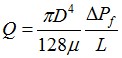
\(Q\) = volumetric flow rate (m³/s)
\(\mu\) = dynamic viscosity of fluid (Pa·s)
Source
Mecanique et Rheologie des fluides en genie chimique, Midoux, Lavoisier 1993, page 162, page 274-275