
Flow regimes : laminar to turbulent
Fluid flow regimes in fluid mechanics explained
Question or remark ? Please contact us at contact@myengineeringtools.com
1. Definitions
2. Flow regimes and Reynolds number limits
1. Introduction
What is a flow regime in fluid mechanics ?
The nature of the flow in a pipe is changing at constant flow, according to the velocity of the liquid in the pipe. This phenomena has been shown by Reynolds in the 19th century.
Reynolds used a transparent pipe to inject a colorant in a flow of water.
At low water velocity, the diffusion of the colorant was perfectly straight (state 1). At a certain velocity, several veins of fluid could be observed (state 2) while past a certain speed, the colorant was mixing immediately in eddies with the water, over the whole pipe section (state 3).
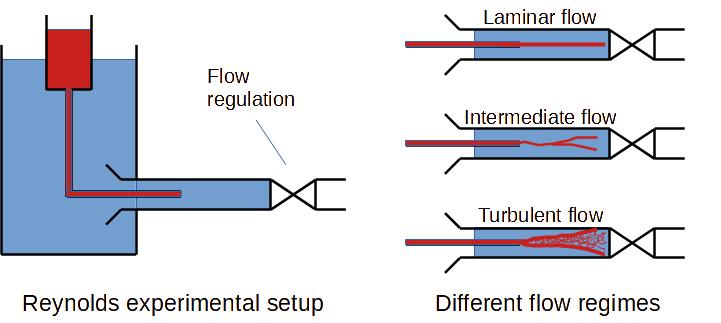
This simple experience allows to highlight the different flow regimes that can be found in a pipe
- (state 1) is LAMINAR flow
- (state 2) is INTERMEDIATE flow
- (state 3) is TURBULENT flow
Reynolds went on in his studies to propose an adimensional number to represent the nature of the flow in a pipe, the Reynolds number.
\[ Re = \frac{\rho \cdot v \cdot D}{\mu} \]
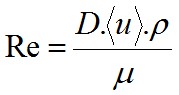
The flow regime is dependent on : the fluid velocity, the pipe diameter, the volumetric mass of the fluid and the viscosity of the fluid. Higher velocity will tend to make the flow more turbulent, while higher viscosity will tend to make it more laminar.
⚙️ Reynolds Number & Flow Regime Calculator
2. Flow regime and Reynolds number
According to the Reynolds number value, the usual limits for a flow in pipes are :2100 < Re < 4000 : intermediary regime
Re > 4000 : turbulent regime
🏭 Practical Plant Engineering Rules of Thumb & Safety Limits
- Laminar flow (Re < 2100): Typically used for viscous fluids (e.g., heavy oils, polymers). Heat transfer is poor; consider static mixers or increased velocity.
- Transitional regime (2100 < Re < 4000): Avoid operating in this range due to unpredictable flow behaviour and vibration. Design either below 2000 or above 4000 for stable operation.
- Turbulent flow (Re > 4000): Standard for most water, solvents, and low-viscosity fluids. Provides good mixing and heat transfer.
- Erosional velocity limit: For liquid lines, keep velocity below \(1.5\)–\(3\) m/s (5–10 ft/s) to prevent erosion and water hammer. For gases, limit to 20–30 m/s (65–100 ft/s).
- Pressure drop consideration: Increasing velocity reduces pipe size but drastically increases friction loss (roughly proportional to \(v^2\)). Balance capital cost against pumping energy.
- Common failure mode: Operating in transitional regime can cause flow-induced vibration and fatigue failure of pipe supports and fittings. Specify conservative Reynolds number targets.