
Terminal velocity of a particle in a fluid: formula, step by step calculation guide
Single particle settling and settling in suspension (hindered settling)
Free terminal velocity Excel Calculator
Follow us on Twitter

Question, remark? Contact us at contact@myengineeringtools.com
1. Introduction
2. Terminal velocity step by step calculation
4. Excel calculator & Online Interactive Tool
1. Introduction
What is the terminal velocity?
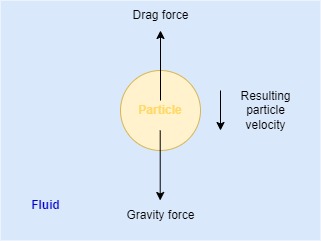
The terminal velocity of a particle in a fluid is the maximum speed that can reach a particle free falling when the gravity forces and the drag forces + the upthrust (Archimedes principle) equal. The calculation of the terminal velocity of a particle is of interest in many unit operations such as the sedimentation of a slurry after liquid-solid mixing, the separation in a cyclone or in a fluid bed.
It should be noted that the terminal velocity of a single particle is different than the terminal velocity of a particle among many others as it is the case in suspensions for example, the presence of other particles indeed hinders the settling of the particle and thus reduces its terminal velocity. This settling velocity in the presence of dense concentration of other particles is called the hindered velocity and can be used to determined at which rate will sediment a suspension.
2. Terminal velocity step by step calculation
How do you find the terminal velocity of a particle?
- The particles considered must have a spherical shape, it could be solid particles, but also liquid in a gas or even a heavier liquid drop in another liquid. However, some limitations apply (\(Re_p < 150000\) for a solid in a gas, \(Re_p < 500\) for a liquid in another liquid, \(Re_p < 100\) for a liquid in a gas)
- In any case, the particle must be heavier than the fluid
- To be noted that a precision of +/-25% is to be expected, results must therefore be interpreted with care
2.1 STEP 1 : Calculate the drag coefficient
The drag coefficient \(K\) can be calculated thanks to the following formula [Mc Cabe]:
\[ K = d_p \left[ \frac{g \cdot \rho_f (\rho_p - \rho_f)}{\mu^2} \right]^{1/3} \]\(K\) = drag coefficient
\(d_p\) = particle diameter (m)
\(g\) = gravity acceleration = 9.81 (\(\text{m.s}^{-2}\))
\(\rho_f\) = fluid density (\(\text{kg/m}^3\))
\(\rho_p\) = particle (material) apparent density (\(\text{kg/m}^3\))
\(\mu\) = fluid viscosity (Pa.s)
2.2 STEP 2 : Determine the coefficients b and n for settling velocity calculation
The coefficients are tabulated according to the value of K. Please refer to the table below to determine b and n.
| Flow Regime |
K |
b |
n |
| Stokes | K < 3.3 | 24 | 1 |
| Intermediate | 3.3 < K < 43.6 | 18.5 | 0.6 |
| Newton | 43.6 < K < 2360 | 0.44 | 0 |
2.3 STEP 3 : Calculate the terminal velocity
The terminal velocity (or settling velocity) can be calculated thanks to the following equation :
\[ U_t = \left[ \frac{4 \cdot g \cdot d_p^{(1+n)} (\rho_p - \rho_f)}{3 \cdot b \cdot \mu^n \cdot \rho_f^{(1-n)}} \right]^{1/(2-n)} \]With :
\(U_t\) = terminal velocity of single particle (not hindered) (m/s)
b and n = coefficient determined at step 2
2.4 STEP 4 : Check validity of the correlation
To check the validity, calculate the Reynolds particle :
The particle Reynolds number can be calculated with the following formula :
\[ Re_p = \frac{d_p \cdot U_t \cdot \rho_f}{\mu} \]\(Re_p\) = Reynolds particle (-)
\(d_p\) = particle diameter (m)
\(U_t\) = terminal velocity of the single particle (not hindered) (m/s)
\(\rho_f\) = fluid density (most probably a liquid) (\(\text{kg/m}^3\))
\(\mu\) = fluid viscosity (Pa.s)
For a solid in a fluid : \(Re_p\) must be < 150000
For a liquid in another liquid : \(Re_p\) must be < 500
For a liquid in a gas : \(Re_p\) must be < 100
3. Hindered settling step by step calculation
What is the terminal settling velocity of a suspension?
A high density of particles settling is influencing the terminal velocity of particles, for example in the case of a liquid-solid suspension. The velocity is then called hindered settling velocity. It is possible to calculate it by 1st determining the volume fraction of solids in suspension, then calculating a Reynolds number for the settling particles.
3.1 STEP 1 : calculate the Reynolds number of a settling particle
The particle Reynolds number can be calculated with the following formula :
\[ Re_p = \frac{d_p \cdot U_t \cdot \rho_f}{\mu} \]3.2 STEP 2 : determine the parameter m
The parameter m can be determined depending on the value of Rep.
| Rep | m |
| Rep < 0.5 | 4.65 |
| 0.5 < Rep < 1300 | \(4.375 \cdot Re_p^{-0.0875}\) |
| Rep > 1300 | 2.33 |
3.3 STEP 3 : calculate the hindered settling velocity
The hindered settling velocity can then be calculated, knowing the volumic fraction \(\varepsilon\) of solid in the suspension and using the following formula to correct the terminal velocity of a single isolated particle [Perry] :
\[ U_t' = U_t \cdot (1 - \varepsilon)^m \]With :
\(U_t'\) = hindered settling velocity of particles in the suspension
(m/s)
\(U_t\) = settling velocity of a single isolated particle calculated
at paragraph 2.3
\(\varepsilon\) = volume fraction of solids in suspension (-)
m = determined at STEP 2
💡 Plant Engineering Best Practices & Rules of Thumb
- Safety Sizing Margin: When designing commercial settling equipment (decanters, clarifiers, thickeners), always apply a safety scale-up factor of 1.5 to 2.0 on the required area. Real-world turbulence and non-spherical geometries severely reduce effective settling rates.
- Hindered vs. Free Settling: Transition to hindered settling typically occurs when the solid volume fraction \(\varepsilon\) exceeds 0.05 (5%). Below this limit, free settling equations yield highly accurate results.
- Viscosity Sensitivity: Settling rates are highly sensitive to fluid temperature. In water, a temperature drop from 20°C to 10°C increases viscosity by almost 30%, which proportionately decreases Stokes settling velocity.
- Limit of Spherical Assumption: For strongly non-spherical particles (e.g., fibers, plates, or organic flocs), modify calculated drag using a sphericity factor \(\psi\). Pure spherical models will over-predict velocities by up to 40%.
4. Interactive Terminal Velocity Calculator
Terminal Velocity & Hindered Settling Sizing Tool
Calculation Results:
4. Excel terminal velocity calculator tool
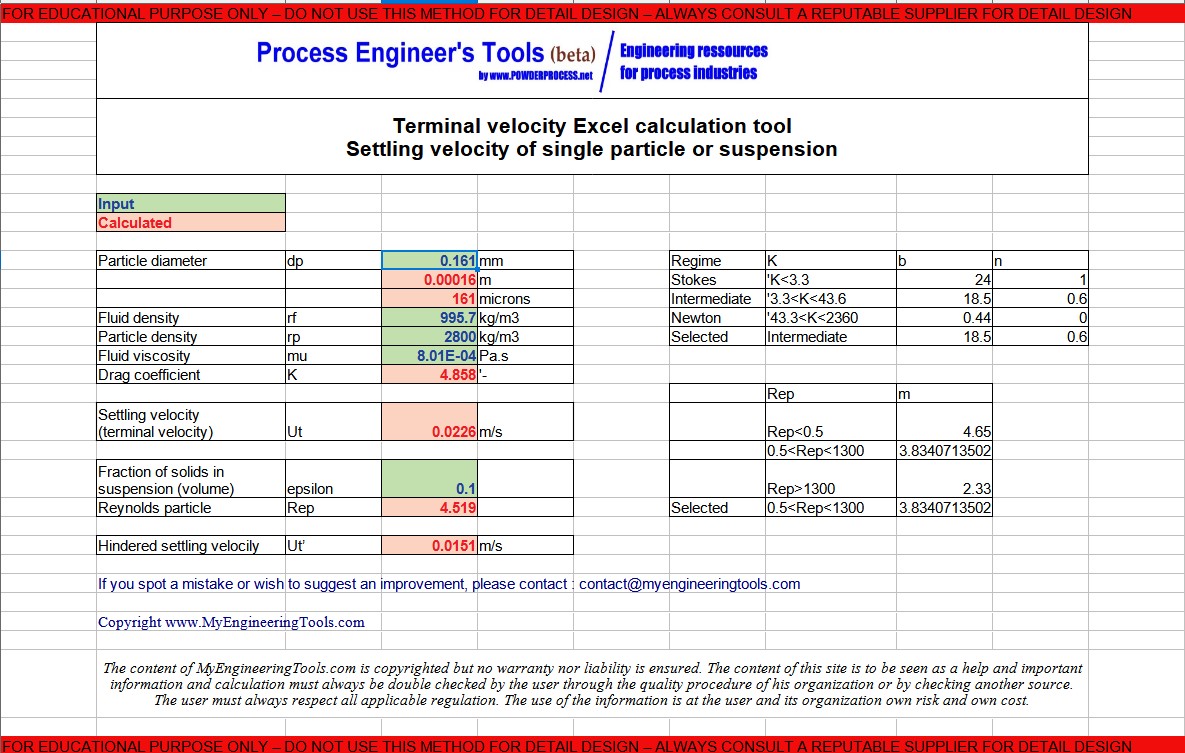
Please access to this page to download the free xls calculation tool matching the calculations shown below.
Warning: this calculator is provided to illustrate the concepts mentioned in this webpage, it is not intended for detail design. It is not a commercial product, no guarantee is given on the results. Please consult a reputable designer for all detail design you may need.
Source:
[McCabe] Unit Operations of Chemical Engineering 7th edition, page 136
[Perry] Perry's Chemical Engineer's Handbook, Section 6 Fluid and Particle Dynamics, page 6-53, McGraw-Hill, 2008