
Churchill correlation (friction factor)
1. Introduction
2. Churchill equation
3. Interactive Sizing Calculator
4. Excel calculation tool
The Churchill equation allows to calculate the friction factor for all flow regimes from laminar to turbulent.
1. Introduction
The friction factor is used to calculate the pressure drop due to the flow of a fluid in a pipe. It represents the interaction in between the fluid and the pipe. There are different ways to calculate it, one can be graphical, using a Moody graph, but for automating calculation it is not practical, thus correlations are required. The Colebrook correlation is usually admitted as being accurate enough for most industrial applications but presents a difficulty as it does not explicitly express the friction factor, that is why it may be interesting to consider Churchill equation that allows to directly calculate the friction factor.
Note that the friction factor used here is Darcy (also called Darcy-Weisbach or Moody) friction factor.
Top 5 Most Popular Tools
2. Churchill equation
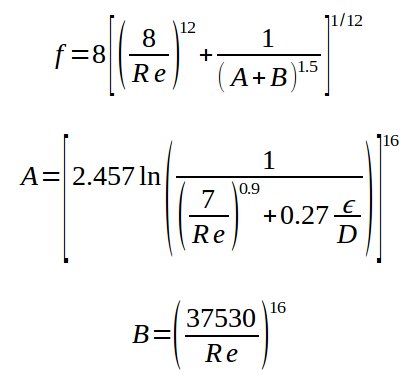
The explicit Churchill correlation (1977) is given by the following set of equations:
\[f = 8 \left[ \left(\frac{8}{Re}\right)^{12} + \frac{1}{(A + B)^{1.5}} \right]^{1/12}\]Where the coefficients \(A\) and \(B\) are defined as:
\[A = \left[ 2.457 \ln \left( \frac{1}{\left(\frac{7}{Re}\right)^{0.9} + 0.27 \frac{\epsilon}{D}} \right) \right]^{16}\] \[B = \left( \frac{37530}{Re} \right)^{16}\]Original Equation reference image:
💡 Churchill Friction Factor Calculator
Calculated Hydraulics Output
📌 Plant Engineering Rules of Thumb: Pipe Roughness & Hydraulics
- Roughness Values (ε): Steel pipes typically scale with corrosion. Use 0.045 mm (0.0018 in) for brand-new commercial steel and 0.15 mm (0.006 in) or more for design margins representing aged/scaled piping.
- Transition Flow Limit: The region between \(2100 < Re < 4000\) is unstable. Churchill yields continuous solutions across this gap, but standard design guidelines advise avoiding operating control valves or pumps in this volatile hydrodynamics zone.
- Hydraulic Sizing Guidelines: Maintain liquid velocities between 1.0 - 1.5 m/s to balance erosional limits against pumping pressure drop penalties.
3. Excel calculation tool
Please access this page to download the free xls calculation tool for Churchill correlation.