
Tank agitator power numbers
Power numbers of common agitators
Question or remark ? Please contact us at contact@myengineeringtools.com
1. Introduction
2. Types of agitators
3. Power number of common agitators
This page is giving some references of power numbers for common agitators.
1. Introduction
The power number is a very important characteristic of any impeller used to agitate a tank as it allows to calculate what will be the power required to rotate the impeller and get a good agitation effect in a tank.
In SI units, the power number is defined as :
Np = P / (ρ.N3.D5)
With :
P = shaft power required (W)
Np = power number (-)
D = impeller diameter (m)
N = agitator speed (r/s)
ρ = liquid density (kg/m3)
If the power number of an agitator is known, it is then possible to calculate the shaft power as :
P = Np.ρ.N3.D5
Now the question is to find out what is the power number for a particular agitator. The best is still to carry out pilot plant trials to define it, or ask specifically to a manufacturer, however it is not always possible and sometimes in pre-project or during troubleshooting we need to be able to make some rough calculations. In such cases, it is possible to use power numbers tabulated for common agitators geometry.
When the Reynolds number is higher than 10000, those power numbers are constant which makes such references particularly useful when the flow in the tank is turbulent.
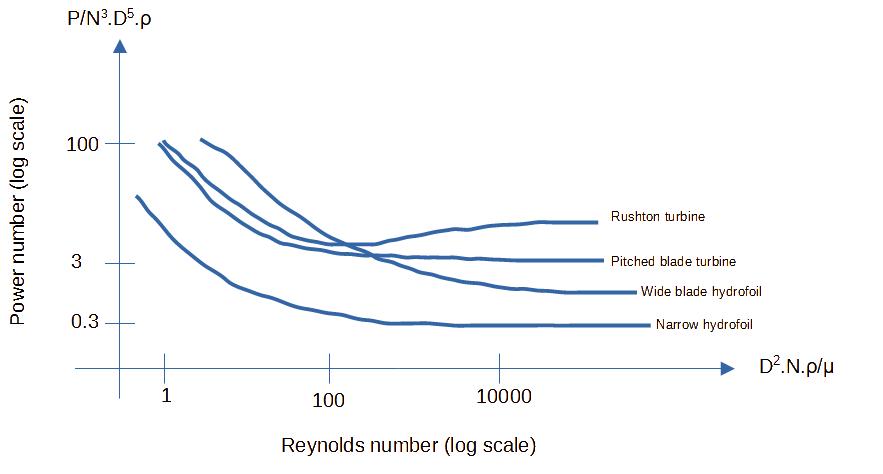
Figure 1 : Power number as a function of Reynolds number, notice as the Power number tends to stay constant at Re > 10000 (approximate values on graph, please refer to table below for values of power number) [Thermopedia]
2. Types of agitators
The following agitators are considered in this page :
-
"Marine" propeller

- Curved blade turbine

- Pitched blade turbine
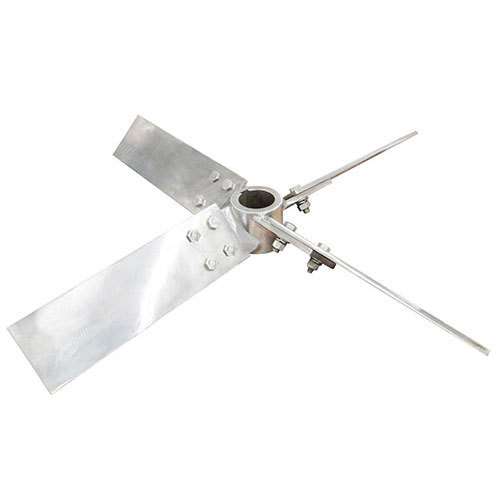
- Flat blade turbine

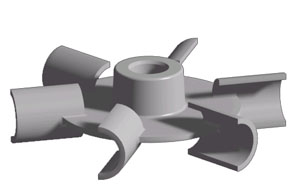
- Hollow blade turbine (Smith)
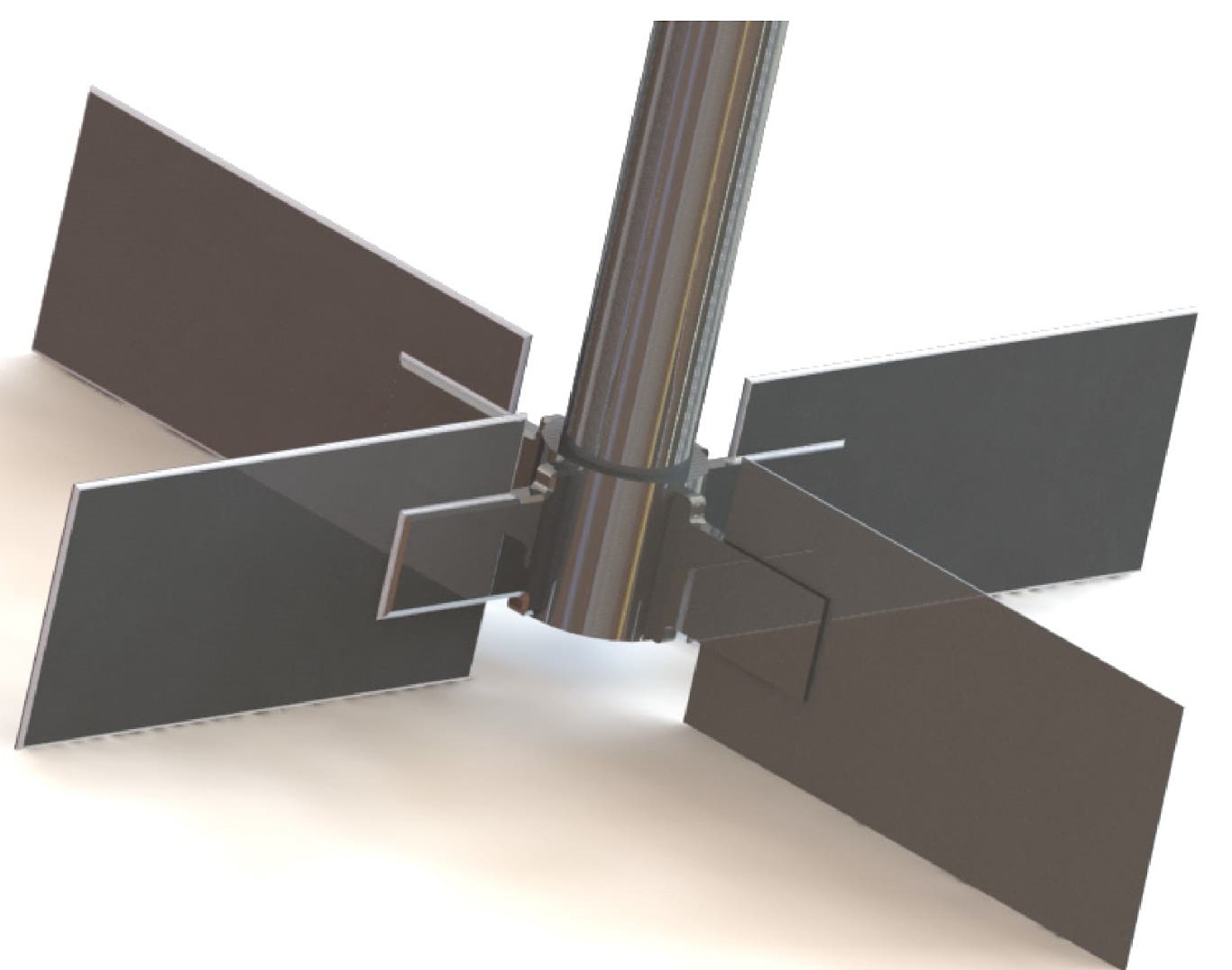
- Flat paddle
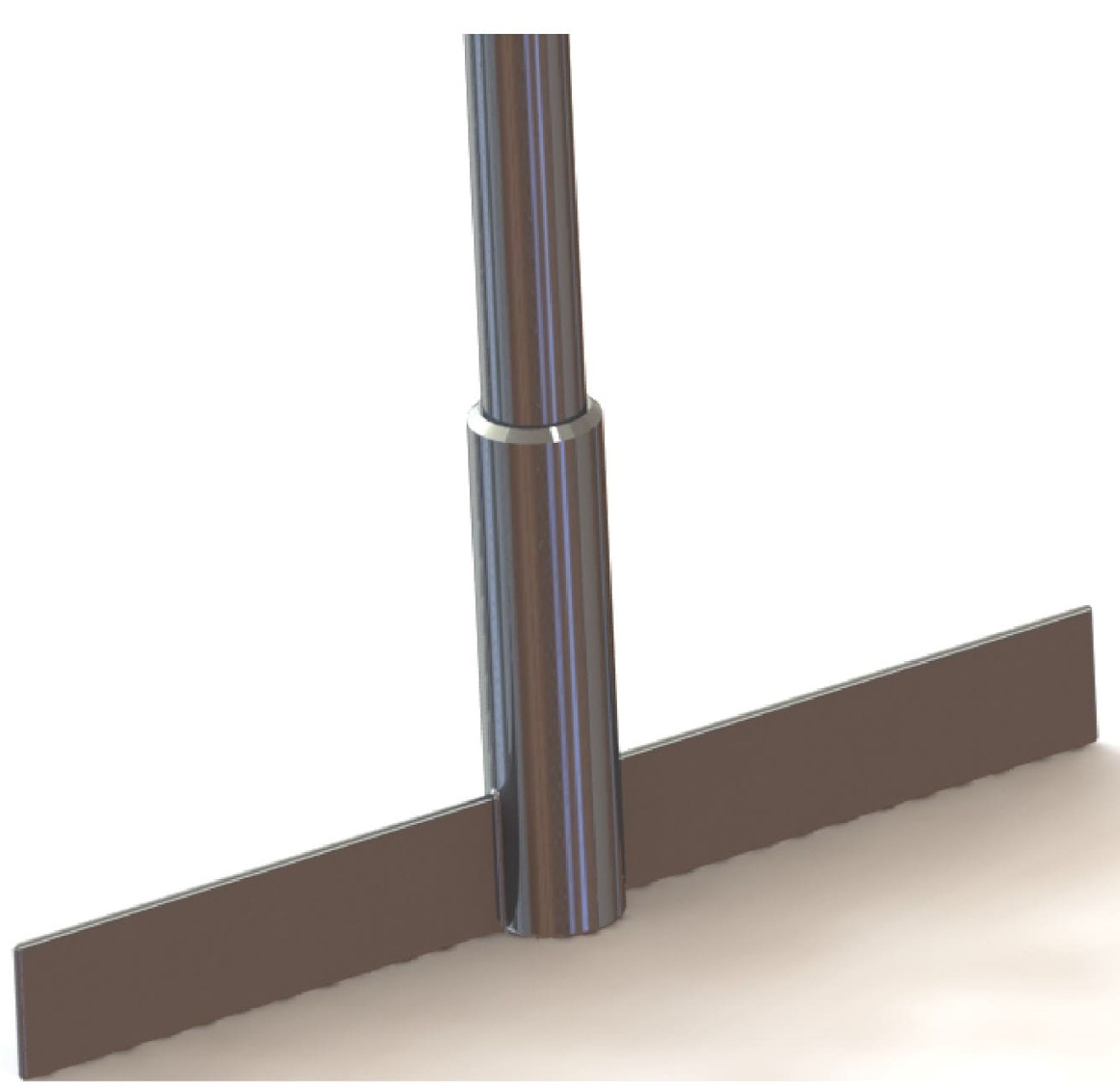
- Straight full blade turbine
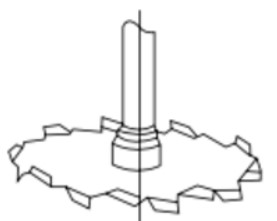
- High shear disc
- Hydrofoil

3. Power number of common agitators
For Reynolds numbers > 10000, the following power numbers are estimated for each of the agitators' geometry.
| Agitator type | T/D | C/D | H/D | L/D | T/C | D/W | C/D |
T/D |
Blades | Pitch | Baffles | Power number |
| Propeller | 3 | 0.75 to 1.3 | 2.7 to 3.9 | 3 | D | 4 Std |
0.35 | |||||
| Marine propeller | 3 | 3 | 5 | 1.0 | 4 Std |
0.34 | ||||||
| Propeller | 3 | 0.75 to 1.3 | 2.7 to 3.9 | 3 | 2D | 4 Std |
0.9 | |||||
| Marine propeller | 3 | 3 | 5 | 1.5 | 4 Std |
0.62 | ||||||
| Pitched blade turbine | 8 | 6 | 45 deg | 4 Std |
1.5 | |||||||
| Pitched blade turbine | 3 | 3 | 5 | 4 | 45 deg | 4 Std |
1.27 | |||||
| Pitched blade turbine | 3 | 3 | 5 | 6 | 45 deg | 4 Std |
1.64 | |||||
| Straight full blade turbine | 8 | 6 | 4 T/B=12 |
3 | ||||||||
| Curved full blade turbine | 8 |
0 deg |
4 Std |
2.7 | ||||||||
| Flat blade turbine | 2.7-3.9 | 0.25 | 5 | 0.75 to 1.3 | 3 | 6 | 0 deg | 4 T/B=6 |
7 | |||
| Flat blade turbine | 2.7-3.9 | 0.25 | 5 | 0.75 to 1.3 | 3 | 6 | 0 deg | 4 T/B=10 |
6 | |||
| Flat blade turbine | 2.7-3.9 | 0.25 | 5 | 0.75 to 1.3 | 3 | 6 | 0 deg | 4 T/B=25 |
4 | |||
| Flat paddle | 3 | 0.75 to 1.3 | 1 | 4 | 2 | 4 Std |
1.8 | |||||
| Hollow blade turbine Smith | 4 Std |
4.1 | ||||||||||
| High shear disk | 4 Std |
0.2 | ||||||||||
| Lightnin A310 (Hydrofoil) |
4 Std |
0.3 | ||||||||||
| Chemineer HE3 (Hydrofoil) |
4 Std |
0.3 |
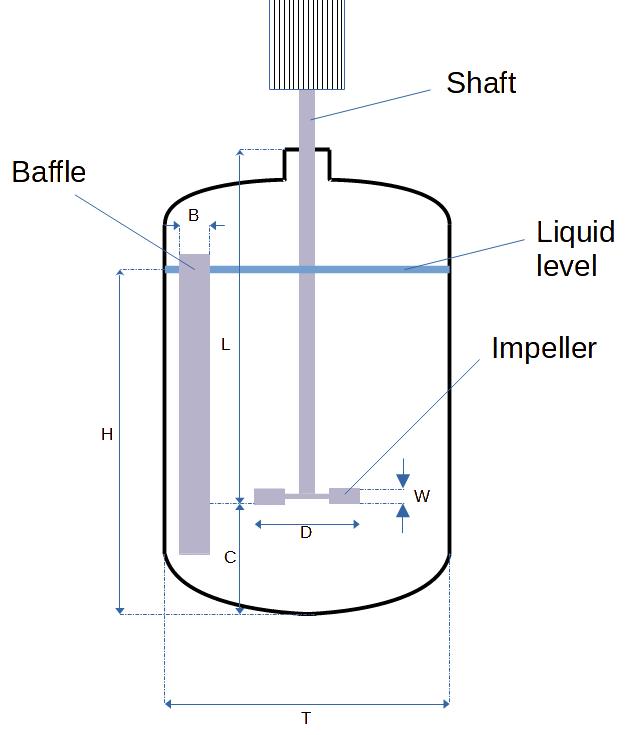
The dimensions referred to in the table are the following :
In terms of patterns of agitation in the tanks, this will depend on wether the agitator is "radial" or "axial". Typical agitation patterns for each type is given on the graph below :

Sources
[Hall] Rules of thumb for Chemical Engineers, Hall, Elsevier, 2018,
pages 104-105
[Pietranski] J. Pietranski, Mechanical agitator power requirements
for liquid batches, K-103 Course Notes, PDH Online
[Thermopedia] Agitation devices, thermopedia.com