
Compressor Power Requirement Calculation
Follow us on Twitter

Question, remark ? Contact us at contact@myengineeringtools.com
| Section summary |
|---|
| 1. Formula to calculate the compressor power required |
| 2. Usual values for calculation |
| 3. Example of calculation |
| 4. Online Interactive Calculator & Free Excel tool |
1. Formula : compressor power calculation
1.1 Simplified formula
For 1 compressor stage of a perfect gas, the isentropic compression is calculated as follows:
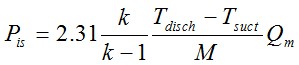
Equation 1 : simplified compression power calculation formula
A compression is said isentropic when it is carried out by an ideal compressor, without friction, without internal leakage and while being perfectly insulated. To account for non‑idealities, the calculation will have to be corrected by an efficiency coefficient (\(\eta\)) dependent on the technology used and which should be precised by the manufacturer; for detailed guidance on determining the screw compression ratio, see the screw compression ratio calculation page.
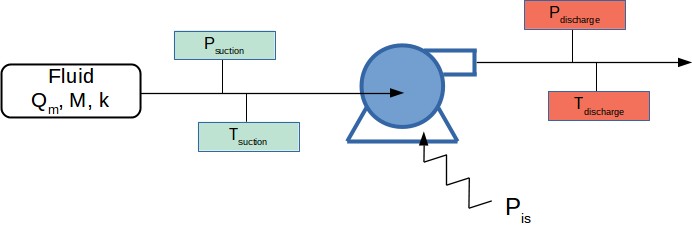
With :
Pis = Power (kW)
Tsuct = Temperature inlet compressor (K)
Tdisch / Tdischarge = Temperature outlet compressor (K)
M = Molar weight of gas (g/mol)
Qm = Compressor throughput (t/h)
k = Gas isentropic coefficient
>>> To know more about this formula please follow this link <<<
One will note that a key unknown in the equation above is the discharge temperature. The discharge temperature Tdischarge can be determined thanks to an abacus or by calculation, for an isentropic compression, please have a look to this page.
1.2 General formula with gas compressibility factor
The following formula can be used for high compression ratio and high temperature ratios that prevent to assume the gas is perfect and its compressibility factor is ~1 :
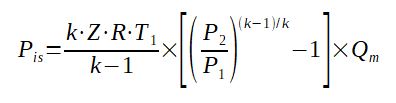
With :
Pis = Power (kW)
Z = gas compressibility factor (can be defined on an Amagat diagram by calculating the reduced pressure and reduced temperature of the gas)
P1 = Pressure inlet compressor (kPa absolute)
P2 = Pressure outlet compressor (kPa absolute)
Qm = Compressor throughput (kg/s)
k = Gas isentropic coefficient
R = [8314/molecular weight (J/(kg.K))]/1000 = 8.314 / molecular weight
>>> To know more about this formula please follow this link <<<
The power calculated must also be corrected by an efficiency coefficient given by the manufacturer of the compressor considered.
Also about compressor calculations on MyEngineeringTools.comCompressor Power formula explained !Reciprocating compressor capacityTemperature rise in a compressor
Polytropic compression
Compressors head and flow coefficients, compression ratio |
2. Usual values for calculations
- For air k=1.4
- Reciprocating compressor high compression rate \(\eta = 0.75\)
- Reciprocating compressor low compression rate \(\eta = 0.75\)
- Rotary screw compressors \(\eta = 0.70\)
Centrifugal compressors : \(\eta\) is calculated from the polytropic efficiency given by the manufacturer. A chart is then used to calculate the polytropic coefficient of the gas, then the discharge temperature calculated and then the actual power needed thanks to the formula 1 above.
For references of industrial compressors and discussions with experts, the reader can refer to the following company (no link with MyEngineeringTools.com) :
www.continental-industrie.com
💡 Plant Engineering Rules of Thumb & Safety Limits
- Discharge Temperature Limit: For reliability, keep discharge temperatures below 150°C (300°F) to prevent carbonization/thermal breakdown of synthetic lubrication oils. Under extreme situations, never exceed 200°C (392°F) to avoid auto-ignition hazards inside the discharge line.
- Compression Ratio (\(r_p\)): Target a compression ratio of 3.5 to 4.0 maximum per stage. If the overall pressure ratio exceeds this, utilize multi-stage configurations with water or air intercooling to optimize energy consumption and protect equipment.
- Design Margin: It is standard industrial practice to size the driver motor with a 10% to 15% safety margin above the calculated shaft power requirement to handle system startup transience or gas composition variations.
3. Example of calculation of the compression power
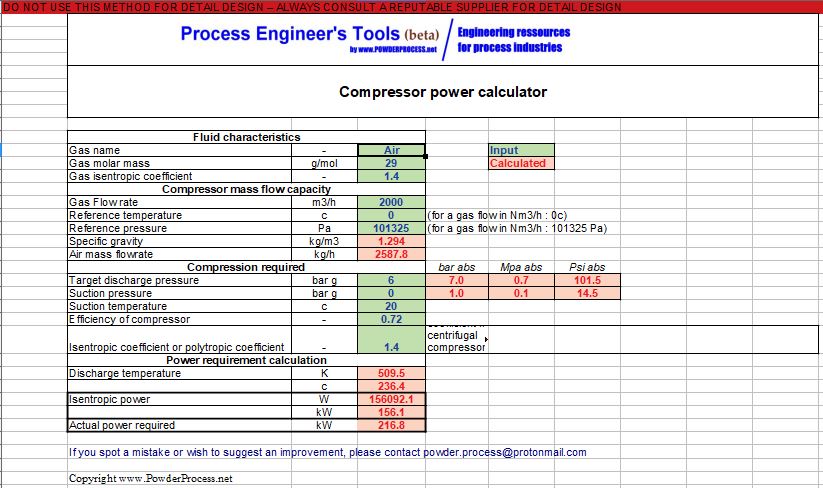
A compressor has to deliver 2000 Nm3/h of air at 6 bar g, from air at atmospheric pressure and 20°C. The efficiency of the compressor is known and is 0.72.
Step 1 : calculate the mass flow rate
The compressor is to deliver 2000 Nm3/h of air. Normal conditions are here defined as 101325 Pa and 0°C [1], at this pressure gas ideality is mostly verified thus the specific gravity is PM/RT/1000 = 1.294 kg/m3. This gives a mass flowrate of 2000*1.294 = 2587 kg/h.
STEP 2 : calculate the discharge temperature
The discharge temperature for an isentropic compression can be calculated with :
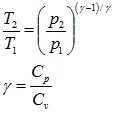
In this case Tdischarge = (20+273.15)*((101325+6*100000)/101325)^((1.4-1)/1.4) = 509.5 K
Which gives 509.5 - 273.15 = 236.4°C
STEP 3 : calculate the isentropic power requirement
Use the formula given above : Pis = 2.31*1.4/(1.4-1)*(236.4-20)/29*2587 / 1000 = 156 kW
STEP 4 : calculate the actual power requirement
The efficiency of the compressor must be taken into consideration and is equal to 0.72 which gives a required power of 156/0.72 = 216.8 kW.
Note : for a centrifugal compressor, the same calculation is done as above, but the isentropic coefficient is replaced by a polytropic coefficient that can be found on charts, knowing the gas isentropic coefficient and the compressor polytropic coefficient as given by the manufacturer
4. Free Excel calculation tool & Online Compressor Calculator
Online Compressor Power Calculator
Calculate the compressor power and temperature rise dynamically (exact physical match to Excel model):
| Calculated Mass Flow (Qm): | 2588 kg/h (2.588 t/h) |
| Compression Ratio (rp = P2/P1 absolute): | 6.92 |
| Calculated Specific Gravity (Density): | 1.294 kg/m³ |
| Discharge Temperature (Tdisch): | 236.4 °C (509.5 K) |
| Isentropic Power (Pis): | 156.1 kW |
| Actual Shaft Power Required (Pact = Pis / η): | 216.8 kW (290.7 HP) |
You can access a free compressor calculator Excel to make the compressor power calculation explained above : Compressor Power Calculator (click here)
Warning : this calculator is provided to illustrate the concepts mentionned in this webpage, it is not intended for detail design. It is not a commercial product, no guarantee is given on the results. Please consult a reputable designer for all detail design you may need.
Source
[1] https://en.wikipedia.org/wiki/Standard_cubic_feet_per_minute
[Perry] Perry's Chemical Engineer's Handbook, Section 10 Transport and storage of fluids, page 10-45, McGraw-Hill, 2008