
Hydraulic Diameter formula and calculation
1. General formula
2. Formula for rectangular duct
What is the hydraulic diameter? The hydraulic diameter, defined as the ratio of four times the flow section to the wetted perimeter, provides an equivalent diameter for non‑circular flows, enabling fluid‑dynamic calculations such as the calculation of hydraulic diameter for non‑circular ducts.
The hydraulic diameter is especially useful when having to calculate a Reynolds number in order to determine the flow regimes (laminar, intermediary, turbulent).
1. Calculation of hydraulic diameter
What is meant by hydraulic diameter ?
The hydraulic diameter is used for non-circular flow and is calculated thanks to the following general formula : DH=4*(flow section)/(wetted perimeter)
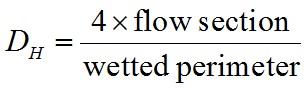
The Hydraulic Diameter formula for 2 simple geometries : rectangular duct and annulus are given below.
2. Hydraulic diameter for rectangular duct
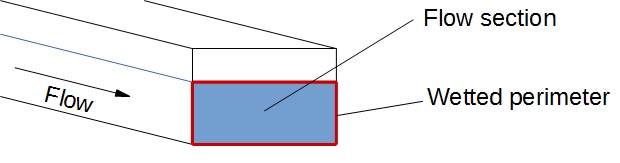

e=Height of the flow section (m)
l=Width of the flow section (m)
3. Hydraulic diameter for annular flow
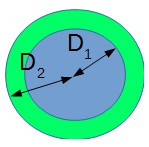
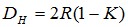
R=Outside diameter of the tube (m)
K=Rinside/R
Rinside=Inside diameter of the tube (m)
4. Hydraulic Diameter Excel Calculator
You can access here an Excel Calculator to calculate the hydraulic diameter defined above.
Warning : this calculator is provided to illustrate the concepts mentioned in this webpage, it is not intended for detail design. It is not a commercial product, no guarantee is given on the results. Please consult a reputable designer for all detail design you may need.
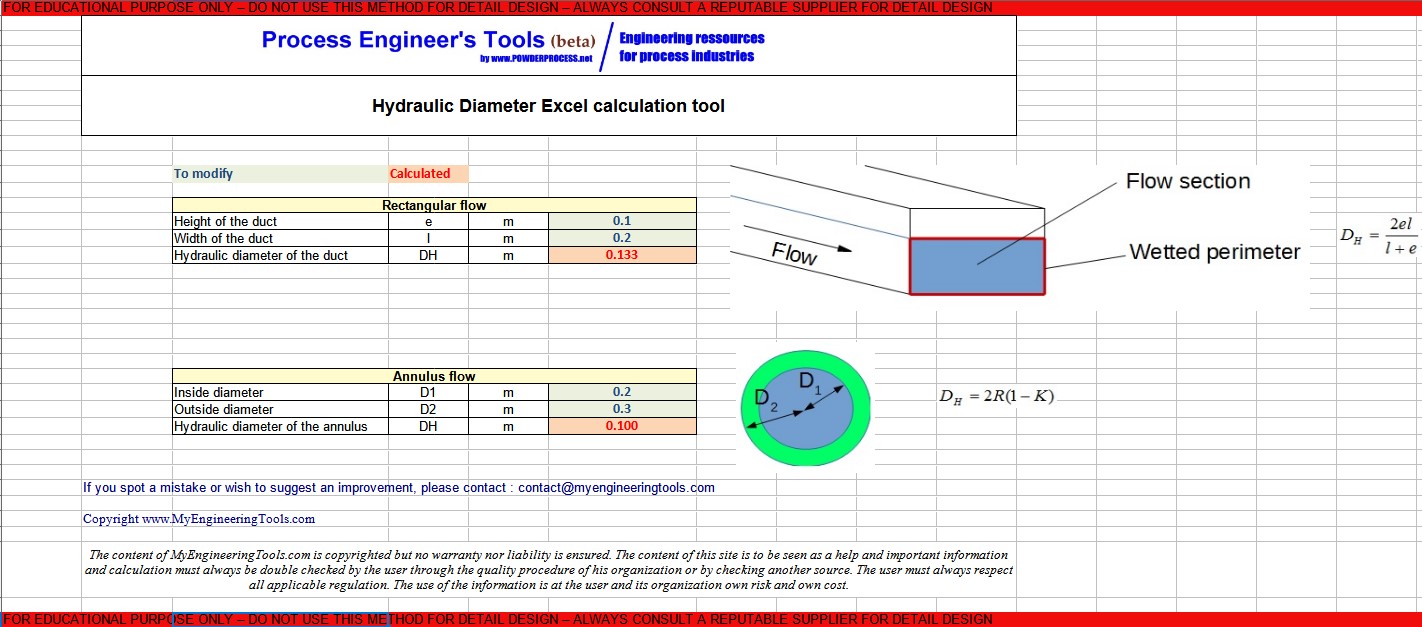
Interactive Hydraulic Diameter Calculator
- For a circular pipe flowing full, DH equals the pipe internal diameter D.
- For a rectangular duct, DH is always smaller than the smallest side; a square duct gives DH = side length.
- For a very wide thin slit (l ≫ e), DH ≈ 2·e.
- For a narrow annulus (K → 1), DH ≈ 2·(R − Rinside) = the annular gap.
- Use DH in the Reynolds number Re = ρ·v·DH/μ to determine the flow regime in non-circular ducts.
- Typical design limits: liquid line velocity ≤ 1.5 m/s (erosional), nozzle/port velocity ≤ 4.5 m/s, total line pressure drop ≤ 3.0 bar (45 psi) for economic pumping.
Mecanique et Rheologie des fluides en genie chimique, Noel Midoux, Lavoisier Tec et Doc, page 197