
Compressor power formula : step by step explanations
Follow us on Twitter 
Question, remark ? Contact us at contact@myengineeringtools.com
| Section summary |
|---|
| 1. Compressor power
simplified formula |
| 2. Explanation of
the formula : step by step |
1. Compressor power simplified formula
In MyEngineeringTools page dedicated to compressor power calculation, there are 2 formula given, a general formula, and a simplified one. The simplified one is the following, for 1 compressor stage of a perfect gas, the isentropic compression is :
Pis = 2.31*(k/(k-1))*(Tdis-Tsuct)/M*Qm
\[ P_{is} = 2.31 \frac{k}{k-1} \frac{T_{dis} - T_{suct}}{M} Q_m \]
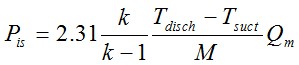
Equation 1 : simplified compression
power calculation formula
Top 5 Most
Popular
1. Compressor
Power Calculation
2. Pump Power Calculation
3. Pipe Pressure
Drop Calculation
4. Fluid Velocity in pipes
5. Churchill Correlation
(friction factor)
With : Pis=Power (kW)
Tsuct=Temperature inlet compressor (K)
Tdischarge=Temperature outlet compressor (K)
M=Molar weight of gas (g/mol)
Qm=Compressor throughput (t/h)
k=Gas isentropic coefficient
Interactive Compressor Power Calculator (Simplified Method)
Calculate isentropic compression power instantly. Toggle units between SI Metric and US Customary.
Calculation Results
🌿 Process Engineering Rules of Thumb & Safety Limits
- Stage Temperature Limit: For reciprocating and centrifugal compressors, discharge temperature should generally not exceed 135°C to 150°C (275°F to 302°F) to prevent lubricating oil degradation, polymer formation, or valve coking.
- Pressure Ratio per Stage: To maintain high adiabatic efficiency and avoid excessive discharge temperatures, single-stage pressure ratios (\(P_2/P_1\)) are typically limited to 3.0 - 4.0 for air/hydrocarbons.
- Polytropic vs. Isentropic: The simplified formula assumes isentropic ($s = \text{const}$) compression with an ideal gas ($Z = 1$). Real gases require compressibility factor corrections ($Z \neq 1$) and polytropic efficiency adjustments.
Now where this formula is coming from, where the 2.31 coefficient is coming from ? As we received a lot of questions on this matter, we decided to propose a dedicated page explaining how to reach this simplified expression, from the general one, as usual in a step by step approach which is the trade mark of MyEngineeringTools.com.
2. Explanation of the formula : step by step
STEP 1 : general equation
We need to start from a more general equation for isentropic compressor power calculation. According to [Perry], the adiabatic head of a compressor is given as :
Had = (k*Z*R*T1)/(k-1)*[(P2/P1)(k-1)/k-1]
\[ H_{ad} = \frac{k \cdot Z \cdot R \cdot T_1}{k-1} \left[ \left(\frac{P_2}{P_1}\right)^{\frac{k-1}{k}} - 1 \right] \]
With : Had= Adiabatic head (N.m/kg)
Z = gas compressibility factor (can be defined on an Amagat diagram
by calculating the reduced pressure and reduced temperature of the
gas)
P1 = Pressure inlet compressor (kPa)
P2 = Pressure outlet compressor (kPa)
k=Gas isentropic coefficient
R = 8314/molecular weight (J/(kg.K))
The work required during the compression is equal to the adiabatic head multiplied by the mass flow rate of gas, and divided by 1000 in order to express it in kW :
Pis (kW) = Had * Qm / 1000
\[ P_{is} (\text{kW}) = \frac{H_{ad} \cdot Q_m}{1000} \]
With : Pis=Power (kW)
Had= Adiabatic head (N.m/kg)
Qm=Compressor throughput (kg/s)
1000 W/kW
This formula is also given on the other page [Perry] :
Pis = (k*Z*R*T1)/(k-1)*[(P2/P1)(k-1)/k-1]*Qm
\[ P_{is} = \frac{k \cdot Z \cdot R \cdot T_1}{k-1} \times \left[ \left(\frac{P_2}{P_1}\right)^{\frac{k-1}{k}} - 1 \right] \times Q_m \]
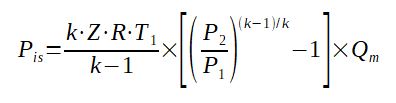
With : Pis=Power (W)
Z = gas compressibility factor (can be defined on an Amagat diagram
by calculating the reduced pressure and reduced temperature of the
gas)
P1 = Pressure inlet compressor (kPa)
P2 = Pressure outlet compressor (kPa)
Qm=Compressor throughput (kg/s)
k=Gas isentropic coefficient
R = [8314/molecular weight (J/(kg.K))]/1000 =
8.314/molecular weight
STEP 2 : Assumptions and simplifications
The general expression is using the gas compressibility factor Z, however in the simplified version we assumed that the gas is a perfect gas, as a consequence the factor is assumed to be 1 : Z = 1
R is actually equal to 8.314 (J/K/kmol) / M (kg/kmol) (see above), it can thus be replaced in the formula :
\[ P_{is} = \frac{8.314}{M} \times \frac{k \cdot T_1}{k-1} \times \left[ \left(\frac{P_2}{P_1}\right)^{\frac{k-1}{k}} - 1 \right] \times Q_m \]

STEP 3 : Introducing isentropic compression
It is possible, via isentropic compression, to relate the pressure change to the temperature change :
\[ \frac{T_2}{T_1} = \left(\frac{P_2}{P_1}\right)^{\frac{k-1}{k}}, \quad k = \frac{C_p}{C_v} \]
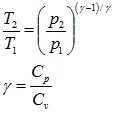
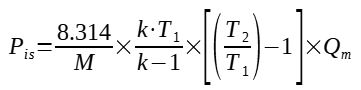
It can then be rearranged :
\[ P_{is} = \frac{8.314}{M} \times \frac{k \cdot T_1}{k-1} \times \left[ \frac{T_2}{T_1} - 1 \right] \times Q_m \]
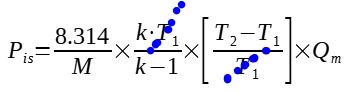
\[ P_{is} = 8.314 \times \frac{k}{k-1} \times \left[ \frac{T_2 - T_1}{M} \right] \times Q_m \]
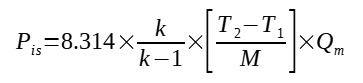
STEP 4 : Convert mass flow to t/h
The simplified formula is based on t/h while the general formula is considering kg/s.
We can then convert :
Qm_kgs / 1000 * 3600 = Qm_th
Qm_kgs = Qm_th * 1000 / 3600
\[ P_{is} = 8.314 \times \frac{k}{k-1} \times \left[ \frac{T_2 - T_1}{M} \right] \times \left( \frac{Q_{m,th} \cdot 1000}{3600} \right) \]

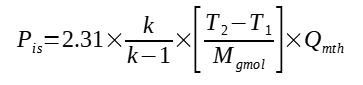
Then 8314 / 3600 = 2.31, gives :
\[ P_{is} = 2.31 \times \frac{k}{k-1} \times \left[ \frac{T_2 - T_1}{M} \right] \times Q_{m,th} \]
[Perry] Perry's Chemical Engineer's Handbook, Section 10 Transport and storage of fluids, page 10-45, McGraw-Hill, 2008