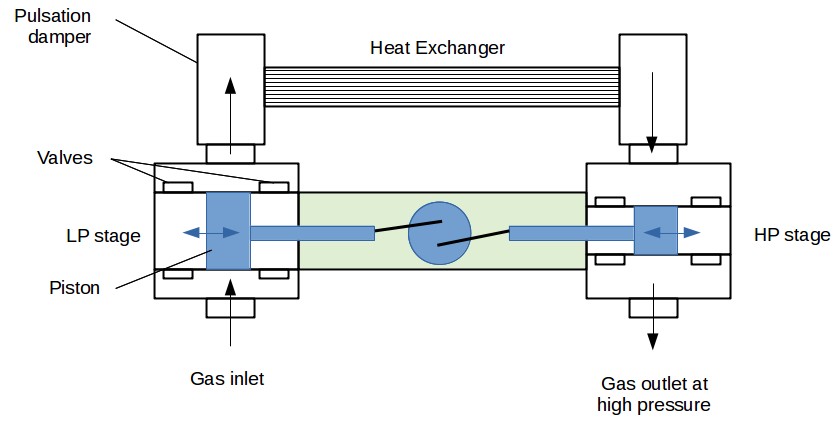
Reciprocating compressor capacity
Follow us on Twitter 
Question, remark ? Contact us at contact@myengineeringtools.com
| Section summary |
|---|
| 1. Reciprocating compressor capacity calculation formula |
| 2. Usual values |
| 3. Other relations (mass flowrate, power) |
| 4. Multistage compression |
1. Reciprocating compressor capacity calculation formula
In a reciprocating compressor, the capacity depends on the volume displaced by the piston during its movement. The swept volume of one piston can be calculated the following way
\\[ V_d = St \cdot \frac{(\pi D^2)}{4} \\]

Not all the cylinder volume can be used for the compression as there is always the clearance at the end of the cylinder that remains with some air inside. This phenomena can be quantified by defining the volumetric efficiency of the compressor

Ev should be calculated rigourously thanks to the actual volume and swept volume, but for quick estimations, the volumetric efficiency can be estimated thanks to the following expression

The volumetric capacity of a single piston can then be calculated thanks to

This value needs to be multiplied by the number of cylinders to find out the capacity of the reciprocating compressor.
With
Vd=Swept volume (m3)
Vs=Actual volume capacity (m3)
Vc=Clearance volume (m3)
c=clearance=Vc/Vd=Swept volume (m3)
Ev=volumetric efficiency (-)
τ=compression ration = pdischarge / psuction(-)
St=Piston Stroke (m)
k=isentropic coeffient (-)
D=Cylinder internal diameter (m)
Reciprocating Compressor Sizing Calculator
⚙️ Practical Plant Engineering Rules of Thumb & Safety Limits:
- Compression Ratio: For single-stage reciprocating compressors, the compression ratio (Pdischarge/Psuction) typically ranges from 3:1 to 5:1. Ratios above 5:1 often necessitate multi-stage compression with intercooling to manage discharge temperatures and improve efficiency.
- Volumetric Efficiency: A good volumetric efficiency for industrial reciprocating compressors is usually in the range of 75-90%. Lower values indicate significant losses, often due to high clearance volume, high compression ratio, or gas leakage. If Ev drops below 0.65, consider it problematic.
- Clearance Volume: Typical clearance values (c) range from 0.04 (4%) for high-pressure applications to 0.16 (16%) for low-pressure, high-volume machines. Higher clearance reduces volumetric efficiency but increases operational flexibility.
- Intercooling: For multi-stage compressors, intercoolers are essential to reduce the gas temperature between stages, decreasing the work required, managing discharge temperatures, and preventing material overstressing. Aim to cool the gas back to near suction temperature before the next stage.
- Piston Speed: Reciprocating compressor piston speeds are generally limited to 3-5 m/s (600-1000 ft/min) to minimize wear, vibration, and dynamic stresses.
- Overall Efficiency: Industrial reciprocating compressors (excluding motor/drive) usually have an overall efficiency (mechanical + volumetric) ranging from 65% to 85%, depending on size, design, and maintenance.
Top 5 Most
Popular
1. Compressor
Power Calculation
2. Pump Power Calculation
3. Pipe Pressure
Drop Calculation
4. Fluid Velocity in pipes
5. Churchill Correlation
(friction factor)
2. Usual values
For air k=1.4
L=0.04 for lubricated compressors (only for estimation)
c must be defined according to the compressor type but should range
from 0.04 to 0.16
3. Other relations (mass flowrate, power)
The mass capacity of the compressor can be calculated, per cylinder with
\\[ Q_M = 12 \cdot \frac{P \cdot M}{T} \cdot Q_v \\]

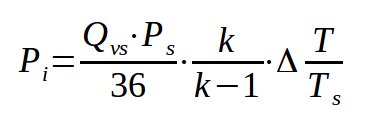
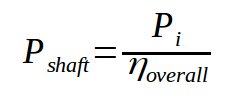
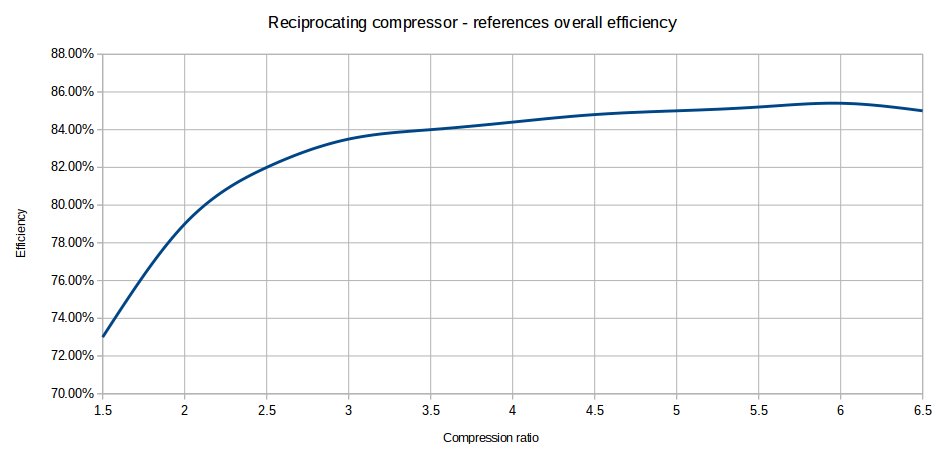
A reciprocating compressor has a cooling system built-in. This particularity, which cannot be implemented for centrifugal compressors, allows to have a discharge temperature close (but not equal) to the isentropic discharge temperature.
4. Multistage compression
Reciprocating compressors are often used in multistage compression with intercoolers in order to maintain the temperatures in a range manageable for the machine. If the compression ratio is > 3, multistage compression is then advised.