
Compressor temperature elevation
Follow us on Twitter 
Question, remark ? Contact us at contact@myengineeringtools.com
| Section summary |
|---|
| 1. Formula - isentropic compression |
| 2. Usual values |
| 3. Polytropic compression |
1. Formula - isentropic compression
For 1 compressor stage
\[ \frac{T_2}{T_1} = \left(\frac{p_2}{p_1}\right)^{(\gamma-1)/\gamma} \]
\[ \gamma = \frac{C_p}{C_v} \]
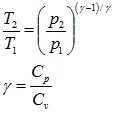
Note : in case of multi staged compressor, if the compression ratio
of each stage is unknown, it can be assumed at 1st approximation
that τone stage=τ1/n
p1=Initial pressure (bar abs)
T2=Temperature outlet compressor (K) - isentropic discharge temperature
p2=Final pressure (bar abs)
τ=p2/p1
n=number of compression stages
Cp=Specific Heat at Constant Pressure (kJ/kg.K)
Cv=Specific Heat at Constant Volume (kJ/kg.K)
Interactive Compressor Temperature Calculator
2. Usual values
For air Cp/Cv=1.4
Top 5 Most
Popular
1. Compressor
Power Calculation
2. Pump Power Calculation
3. Pipe Pressure
Drop Calculation
4. Fluid Velocity in pipes
5. Churchill Correlation
(friction factor)
3. Polytropic compression
Polytropic compression calculation, used for centrifugal compressors, is giving a discharge temperature higher than the isentropic compression model.
However, to be able to calculate the polytropic compression discharge temperature, it is necessary to know the polytropic compression coefficient n of the compressor. The polytropic coefficient can be calculated by knowing the polytropic efficiency of the compressor, given by the manufacturer, and an abacus.
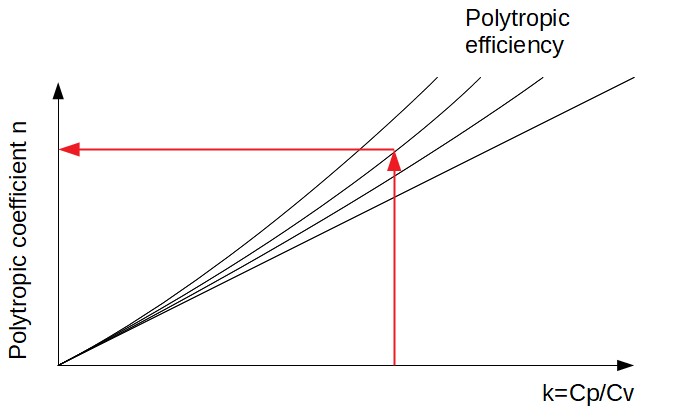
Figure 1 : principle of an abacus allowing to calculate the polytropic coefficient for a centrifugal compressor
The same formula used for isentropic discharge temperature
calculation can be applied but by replacing the isentropic
coefficient by the polytropic coefficient.
T2 = T1.τn
With
T1=Temperature entry compressor (K)
p1=Initial pressure (bar abs)
T2=Temperature outlet compressor (K) - isentropic
discharge temperature
p2=Final pressure (bar abs)
τ=p2/p1
n=polytropic coefficient
🏭 Practical Plant Engineering Rules of Thumb & Safety Limits
- Maximum Discharge Temperature Limits: For hydrocarbon and lubricated air compressors, discharge temperature should be limited to 135°C to 150°C (275°F to 300°F) to prevent lubricating oil degradation, carbon deposition, and valve coking.
- Stage Compression Ratio Limit: To avoid excessive discharge temperatures and mechanical stress, single-stage pressure ratio (\(\tau\)) should generally not exceed 3.5 to 4.0 for air and light hydrocarbon gases.
- Intercooling Design: When overall pressure ratio exceeds limits, multi-stage compression with intercoolers returning gas to ambient inlet temperature is mandatory to save compression power and maintain safe metallurgy.
- Polytropic vs Isentropic: Real centrifugal compressors operate polytropically. Polytropic efficiency (\(\eta_p\)) typically ranges from 75% to 85% depending on machine size and Reynolds number.
Source
Pneumatic Conveying Design Guide, David Mills, Elsevier Butterworth-Heinemann, 2004