
Active, Reactive, and Apparent Power calculation
What are the different kinds of power of a motor and how to calculate them
Follow us on Twitter 
Question, remark ? Contact us at contact@myengineeringtools.com
| Section summary |
|---|
| 1. Introduction |
| 2. Active Power
(Real Power) |
| 3. Reactive Power |
| 4. Apparent Power |
| 5. Differences between Active, Reactive, and Apparent Power |
⚡ Interactive AC Power Calculator
Calculate Active Power (P), Reactive Power (Q), Apparent Power (S), Phase Angle, and Power Factor Correction requirements for single-phase and 3-phase systems.
1. Introduction
In electrical engineering, the concepts of active power, reactive power, and apparent power are indispensable to understand the behavior of alternating current (AC) circuits. These parameters play key roles in ensuring efficient energy transmission and consumption. In this page, those different kinds of power are explained, along with methods on how to calculate them.
2. Active Power (Real Power)
Active power, often referred to as real power, is a fundamental electrical parameter measured in watts (W). It represents the actual power consumed or produced by an electrical device, which is responsible for performing useful work. Active power is what powers lights, turns motors, and runs electronic devices.
3.1 Active power calculation for single phase current
Active power can be calculated using the following formula for single phase current motors :
\[ P = U \cdot I \cdot \text{PF} \]
(\(\text{PF} = \cos \varphi\))
\[ P = U \cdot I \cdot \cos \varphi \]
Top 5 Most
Popular
1. Compressor
Power Calculation
2. Pump Power Calculation
3. Pipe Pressure
Drop Calculation
4. Fluid Velocity in pipes
5. Churchill Correlation
(friction factor)
Where:
P = Active power (W)
U = voltage in volts (V).
I = current in amperes (A).
φ = phase angle difference between voltage and current
PF = Power Factor
3.2 Active power calculation for three phase current
Active power can be calculated using the following formula for 3-phase current motors :
\[ P = \sqrt{3} \cdot U \cdot I \cdot \text{PF} \]
(\(\text{PF} = \cos \varphi\))
\[ P = \sqrt{3} \cdot U \cdot I \cdot \cos \varphi \]
Where:
P = Active power (W)
U = voltage in volts (V).
I = current in amperes (A).
φ = phase angle difference between voltage and current
PF = Power Factor
3.3 Active power measurement
Measuring active power is typically accomplished using a device called a wattmeter, which directly reads the active power in a circuit.
3. Reactive Power
Reactive power, denoted as Q, is a vital component of AC power systems. It is measured in volt-amperes reactive (VAR). Reactive power does not perform any useful work but is essential for maintaining voltage levels and supporting the operation of inductive loads like motors and transformers, as well as capacitive loads like capacitors.
3.1 Reactive power calculation for single phase current
Reactive power can be calculated using the following formula for single phase current motors :
\[ Q = U \cdot I \cdot \sin \varphi \]
Where:
Q = reactive power (VAR)
U = voltage in volts (V).
I = current in amperes (A).
φ = phase angle difference between voltage and current
3.2 Reactive power calculation for three phase current
Reactive power can be calculated using the following formula for 3-phase current motors :
\[ Q = \sqrt{3} \cdot U \cdot I \cdot \sin \varphi \]
Where:
Q = reactive power (VAR)
U = voltage in volts (V).
I = current in amperes (A).
φ = phase angle difference between voltage and current
The calculation of reactive power involves trigonometric relationships within the power triangle, formed by active power, reactive power, and apparent power.
💡 Industrial Engineering Rules of Thumb & Design Limits
- Power Factor Target: Industrial facilities aim for a minimum power factor of 0.92 to 0.95 lagging to eliminate reactive power utility penalties and avoid thermal overload on supply transformers.
- Equipment Sizing (kVA vs kW): Switchgear, circuit breakers, and transformers must always be rated based on Apparent Power (\(S\) in kVA), not Active Power (\(P\) in kW), because conductor heating is dictated by total current \(I = S / (\sqrt{3} U)\).
- Induction Motor Behavior: Full-load motor power factors typically range from 0.82 to 0.88. At partial loads (under 50% rating), the power factor degrades drastically to 0.30–0.50, requiring local capacitor compensation.
- Capacitor Bank Placement: Install Power Factor Correction (PFC) capacitor banks as close to large inductive loads (motors/compressors) as practical to reduce upstream cable losses (\(I^2 R\)) and free up upstream capacity.
4. Apparent Power
Apparent power, symbolized as S and measured in volt-amperes (VA), is the vector sum of active power and reactive power. It represents the total power flow in an AC circuit, encompassing both the power that performs work (active) and the power that oscillates back and forth (reactive).
4.1 Apparent power general formula
The apparent power, often noted as S, can be calculated when knowing the real power and the reactive power of a motor :
\[ S = \sqrt{P^2 + Q^2} \]
With
S = apparent power (VA)
Q = Reactive power consumption (VAR)
P = Active power consumption (W)
5. Differences between Active, Reactive, and Apparent Power
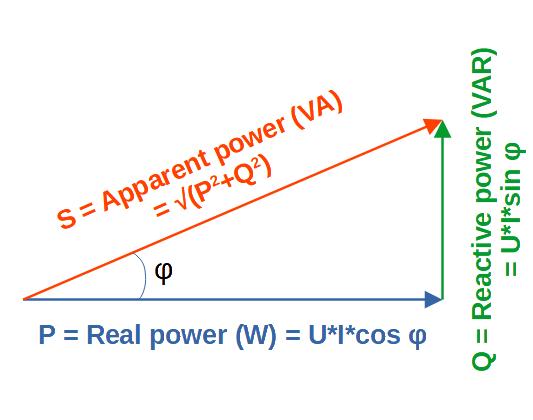
To differentiate these types of power, consider the following:
- Purpose : Active power performs useful work (e.g., lighting a bulb), reactive power maintains voltage (e.g., inductive loads), and apparent power represents the total power flow.
- Units : Active power is measured in watts (W), reactive power in volt-amperes reactive (VAR), and apparent power in volt-amperes (VA).
- Calculation : Active power is directly measured using wattmeters, while reactive power and apparent power are calculated using relevant formulas (see above).
- Effect on Systems : Active power consumption directly affects utility bills, while reactive power affects system voltage stability. Apparent power reflects the capacity required from power sources.
In summary, active power is the tangible effect of electrical
systems, reactive power stabilizes voltage, and apparent power
encapsulates the complete power picture.