Volume of an horizontal cylinder tank : step by step calculation guide
How to calculate the volume of an horizontal cylindrical tank
Follow us on Twitter 
Question, remark ? Contact us at contact@myengineeringtools.com
1. Horizontal cylindrical tank
4. STEP 3 : Total volume
5. Excel horizontal tank volume calculator
1. Horizontal cylindrical tank
An horizontal tank is made of cylindrical shell and of 2 ends that can take different standard shapes. Many horizontal vessels are used in process industries, be it just to store water, or to hold chemicals in a road tanker for instance.
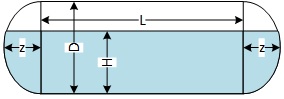
With :
D = tank diameter (m)
H = actual height of liquid in the tank (m)
z = tank head height (m)
L = length of the cylindrical shell (m)
The tank heads can have the following shapes :
- Elliptical
- Torispherical
- Hemispheric
This page is explaining how to calculate the volume in the tank as
a function of the level of liquid H.
Horizontal Tank Volume Calculator
Calculation Results
Total Cylindrical Volume: m³
Partial Cylindrical Volume: m³
Total Head Volume (2 heads): m³
Partial Head Volume (2 heads): m³
Total Tank Volume (Full): m³
Total Tank Volume (Filled): m³
Top 5 Most
Popular
1. Compressor
Power Calculation
2. Pump Power Calculation
3. Pipe Pressure
Drop Calculation
4. Fluid Velocity in pipes
5. Churchill Correlation
(friction factor)
2. STEP 1 : Volume of the cylindrical section
2.1 Total volume
The total volume of a cylinder is given by the following formula :
\[V_{cyl\_total} = \pi \cdot \frac{D^2}{4} \times L\]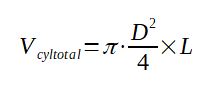
2.2 Partial volume horizontal cylinder
The actual volume in the cylinder actually depends on the height of liquid H in the tank. The partial volume filled can be calculated with the following equation :
\[V_{cylpartial} = L \cdot \frac{D^2}{4} \left( \sin^{-1}\left(2\frac{H}{D}-1\right)+\frac{\pi}{2}+\left(2\frac{H}{D}-1\right)\sqrt{2\frac{H}{D}\left(2-2\frac{H}{D}\right)} \right)\]
3. STEP 2 : Volume in the tank ends
3.1 Total volume in tank heads
| Elliptical | \[V = \pi \cdot \frac{D^3}{24}\] |
| Torispherical | \[V = 0.1 \cdot D^3\] |
| Hemispheric | \[V = \pi \cdot \frac{D^3}{12}\] |
3.2 Partial volume in tank heads
The volume in the tank end depends on the standard shape.
| Elliptical |
\[V = 0.2618 \cdot H^2 \cdot \left(\frac{3D}{2}-H\right)\]
 |
| Torispherical |
\[V = 0.2 \cdot H^2 \cdot \left(\frac{3D}{2}-H\right)\]

|
| Hemispheric |
\[V = 0.5236 \cdot H^2 \cdot \left(\frac{3D}{2}-H\right)\]

|
Practical Plant Engineering Rules of Thumb & Safety Limits
- Level Measurement Accuracy: For precise inventory control, ensure level transmitters are regularly calibrated. The accuracy of the calculated volume heavily relies on the accuracy of the liquid height (H) measurement.
- Tank Strapping & Calibration: For commercial transactions or custody transfer, tanks are typically 'strapped' or calibrated to create a precise volume table. This calculator provides theoretical values and should not replace certified strapping tables.
- Overfill Protection: Always design with high-level alarms and trips to prevent overfilling, which can lead to spills, environmental damage, and safety hazards. Consider a minimum ullage (vapor space) even for 'full' conditions.
- Minimum Operating Level: For pumps connected to the tank, ensure a minimum liquid level (NPSH available) is maintained to prevent cavitation and damage to the pump.
- Vent Sizing: Tanks must be adequately vented to prevent over-pressurization or vacuum formation during filling/emptying and thermal breathing. The tank volume plays a role in vent sizing.
- Structural Integrity: Be mindful of the weight of the liquid. The design should account for the maximum liquid density and volume to ensure the tank structure and supports are adequate.
4. STEP 3 : Total volume
Vtotal = Vcylinder + 2*Vhead
(assuming both heads are identical)
5. Excel horizontal tank volume calculator
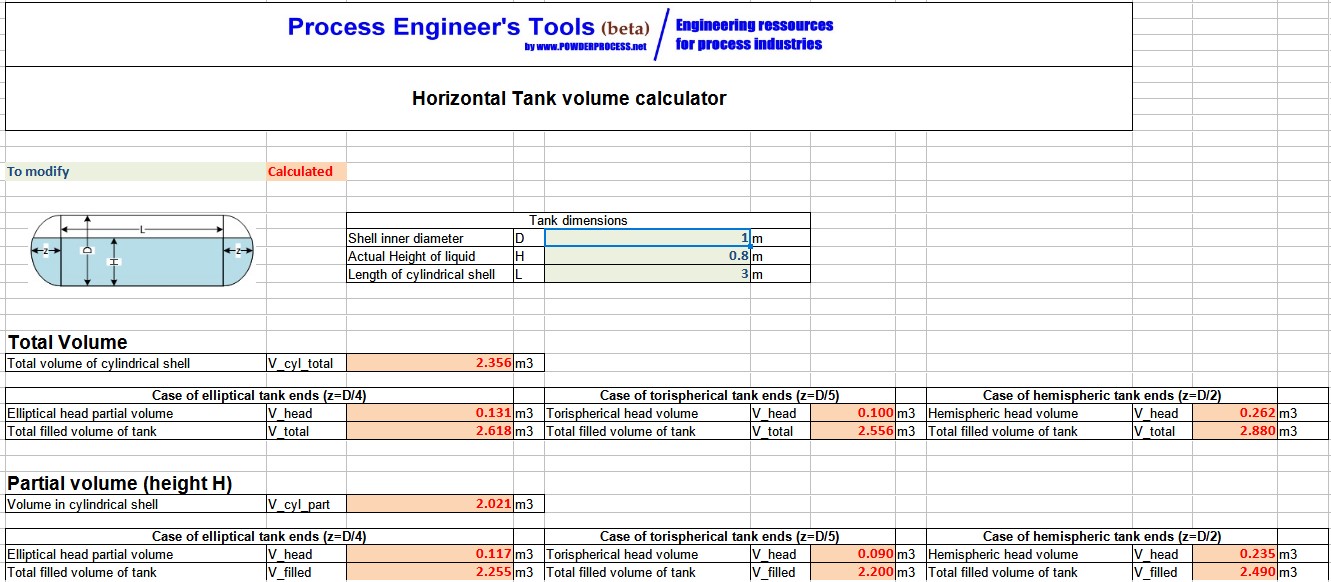
You can download a calculator to compute the volume of a partially filled horizontal tank : Horizontal Tank volume Excel calculation tool (click here).
Warning : this calculator is provided to illustrate the concepts mentioned in this webpage, it is not intended for detail design. It is not a commercial product, no guarantee is given on the results. Please consult a reputable designer for all detail design you may need.