
Surface roughness of common materials
Pipe roughness for friction factor and pressure drop calculation
Follow us on Twitter

Question, remark ? Contact us at contact@myengineeringtools.com
| Section summary |
|---|
| 1. Surface roughness of common materials |
| 2. Relative roughness |
| 3. Interactive Roughness Calculator |
1. Surface roughness of common materials
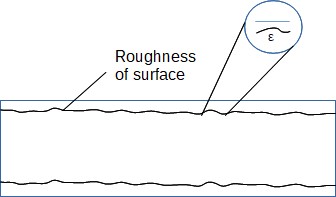
What is the surface roughness of a steel pipe? What is the surface roughness of concrete? The roughness is actually a measurement of all the asperities at the surface of a material, especially a pipe where it will oppose the flow of fluid.
Pipe Relative Roughness Calculator
Industrial Best Practices & Rules of Thumb
- Standard Steel: For new commercial steel pipes, \(\epsilon = 0.05\) mm is the standard engineering assumption.
- Aging Allowance: Always consider a "fouled" or "rusted" roughness for long-term hydraulic calculations. Roughness can increase by 5-10x over 20 years in corrosive services.
- Critical Limit: If \(\epsilon/D > 0.05\), the pipe is considered "extremely rough." Pressure drop correlations like Colebrook-White may be less accurate.
- Plastic Advantage: PVC and HDPE (\(\epsilon \approx 0.005\) mm) offer significantly lower pressure drops than steel, allowing for energy savings or smaller diameters.
The following table summarizes usual pipe roughness for many materials used for piping or ducts:
| Material | Absolute Roughness (mm) |
|---|---|
| Steel pipe - stretched | 0.015 |
| Steel pipe - commercial, laminated - NEW | 0.05 |
| Steel pipe - commercial, laminated - RUSTED | 0.15-0.25 |
| Steel pipe - welded NEW | 0.03-0.1 |
| Steel pipe - welded RUSTED | 0.4 |
| Iron pipe - galvanized | 0.15-0.20 |
| Cast iron - molded NEW | 0.25 |
| Cast iron - molded RUSTED | 1-1.5 |
| Glass, copper or brass stretched pipe | 0.001 |
| Concrete pipe - smoothed | 0.3-0.8 |
| Concrete pipe - coarse | 3 |
| Plastic pipe | 0.002-0.007 |
| Wood - ordinary | 1-2.5 |
| Stone (cut) | 8-15 |
For steel pipes, when nothing more is specified, 0.05 mm is a good first approximation.
2. Relative roughness
The relative roughness is calculated by dividing the absolute pipe roughness (\(\epsilon\)) over the pipe internal diameter (\(D\)). Both values must be in the same units.
\[ \text{Relative Pipe Roughness} = \frac{\epsilon}{D} \]In a more general expression for non-circular ducts, the diameter can be replaced by the hydraulic diameter (\(D_h\)).
What is the pipe roughness used for? The pipe relative roughness is used to calculate the friction factor (using correlations like Colebrook-White or Churchill), which is then used to determine the pressure drop for a fluid flow. You can visualize these relationships on the Moody chart.
Source:
Mecanique et Rheologie des fluides en genie chimique, Midoux, Lavoisier Tec et Doc, page 277