
Air Viscosity
Follow us on Twitter

Question, remark ? Contact us at contact@myengineeringtools.com
1. Air viscosity at ambient temperature
2. Air Viscosity in between -100 and 500°c
3. Air viscosity variation with pressure
4. Detailed Viscosity Data & Practical Engineering Applications
5. Air‑Viscosity Calculator (Sutherland’s Law)
1. Air viscosity at ambient temperature
What is the viscosity of air ?
The viscosity of air at atmospheric pressure is the following :
- Air viscosity at 0°c = 0.01722 mPa.s (\(1.722 \times 10^{-5} \text{ Pa}\cdot\text{s}\))
- Air viscosity at 25°c = 0.0184 mPa.s (\(1.84 \times 10^{-5} \text{ Pa}\cdot\text{s}\))
2. Air viscosity in between -100 and 500°c
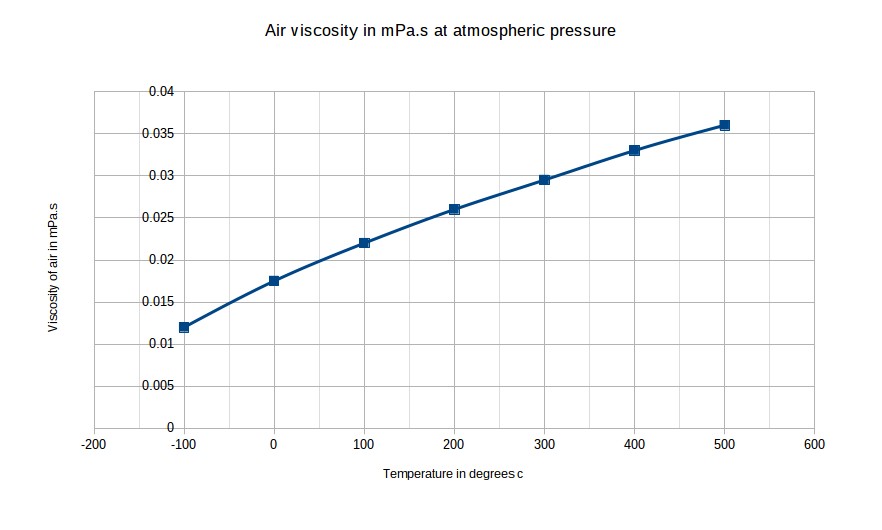
How the air viscosity change with temperature ?
The air viscosity depends on the temperature and is increasing with the temperature. The evolution of air dynamic viscosity with the temperature is illustrated by the graph below.
Top 5 Most Popular
1. Compressor Power Calculation
2. Pump Power Calculation
3. Pipe Pressure Drop Calculation
4. Fluid Velocity in pipes
5. Churchill Correlation (friction factor)
3. Variation with pressure
How the air viscosity vary with pressure ?
The viscosity is increasing with the pressure. To estimate the viscosity of air according to the pressure, abacus using reduced pressure and reduced temperature can be used for an estimation.
4. Detailed Viscosity Data & Practical Engineering Applications
The dynamic viscosity of air varies predictably with temperature. The most widely‑used representation is Sutherland’s law, which provides an accurate (< ± 2 %) estimate for ordinary pressures and a broad temperature range [0][1][2].
Sutherland's formula is expressed mathematically as:
\[ \mu = \mu_0 \left( \frac{T}{T_0} \right)^{3/2} \frac{T_0 + S}{T + S} \]
Where:
- \(\mu\) = dynamic viscosity at target absolute temperature \(T\) (in Kelvin)
- \(\mu_0 = 1.716 \times 10^{-5} \text{ Pa}\cdot\text{s}\) (reference viscosity at \(T_0 = 273.15 \text{ K}\))
- \(T_0 = 273.15 \text{ K}\) (\(0\ ^\circ\text{C}\))
- \(S = 110.4 \text{ K}\) (Sutherland constant for air)
Using these reference values, the table below lists the dynamic viscosity (\(\mu\)) from –100 °C to 500 °C. Values are expressed in µPa·s (\(1\ \mu\text{Pa}\cdot\text{s} = 10^{-6}\ \text{Pa}\cdot\text{s}\)) for easier comparison with typical engineering data [0].
| Temperature (°C) | Dynamic Viscosity µ (µPa·s) | Dynamic Viscosity µ (cP) |
|---|---|---|
| -100 | 11.7 | 0.0117 |
| 0 | 17.2 | 0.0172 |
| 25 | 18.4 | 0.0184 |
| 100 | 21.7 | 0.0217 |
| 200 | 25.7 | 0.0257 |
| 300 | 29.3 | 0.0293 |
| 400 | 32.5 | 0.0325 |
| 500 | 35.5 | 0.0355 |
Typical Engineering Scenarios Where Air Viscosity Is Critical
- Duct‑flow Reynolds number – Determines laminar vs. turbulent regime.
Example: 0.5 m diameter ventilation duct, air at 20 °C (\(\rho \approx 1.204 \text{ kg}\cdot\text{m}^{-3}\), \(\mu \approx 18.1 \ \mu\text{Pa}\cdot\text{s}\)). With a mean velocity of 5 m·s⁻¹: \[ Re = \frac{\rho V D}{\mu} \approx \frac{1.204 \times 5 \times 0.5}{1.81 \times 10^{-5}} \approx 1.66 \times 10^5 \quad (\text{Fully Turbulent}) \] - Pressure‑drop calculations (Darcy–Weisbach) – The friction factor depends on Reynolds number, which in turn uses \(\mu\). Accurate \(\mu\) values improve fan and blower sizing.
- Heat‑transfer correlations (e.g., Dittus‑Boelter, Gnielinski) – Both Nusselt and Prandtl numbers require \(\mu\) (through kinematic viscosity \(\nu = \mu / \rho\)). This is essential for HVAC coil design, electronic cooling, and gas‑turbine blade cooling.
- Aerodynamic drag & lift predictions – In CFD and wind‑tunnel simulations, the air’s viscosity sets the viscous sub‑layer thickness and influences boundary‑layer separation.
- Spray‑drying & particulate transport – Viscosity controls the Stokes number, affecting particle settling and residence time in dryers or cyclones.
💡 Practical Engineering Rules of Thumb & Safety Limits
- Gases vs. Liquids Trend: Unlike liquids (where dynamic viscosity drops as temperature rises), air viscosity increases with temperature due to increased molecular speed and kinetic momentum transfer.
- Pressure Independence Limit: Up to 10 bar (145 psi), air dynamic viscosity is essentially independent of pressure. Above 10 bar, dense gas effects increase viscosity beyond Sutherland's prediction.
- Sutherland Accuracy Window: Sutherland's equation is valid for air between 100 K (-173 °C) and 1900 K (1627 °C) with an accuracy within ±2%.
- Kinematic Viscosity Expansion: Because air density drops inversely with absolute temperature (\(\rho \propto 1/T\)) while dynamic viscosity rises (\(\mu \propto T^{0.75}\)), kinematic viscosity (\(\nu = \mu/\rho\)) grows rapidly with temperature.
5. Interactive Air‑Viscosity Calculator (Sutherland’s Law)
Calculation Summary Results
Sources
| # | Source | Title / Description | URL |
|---|---|---|---|
| 0 | Engineers Edge | Viscosity of Air, Dynamic and Kinematic – Provides standard dynamic‑viscosity values (e.g., 18.6 µPa·s at 25 °C) and a concise summary of Sutherland’s law. | https://www.engineersedge.com/physics/viscosity_of_air_dynamic_and_kinematic_14483.htm |
| 1 | MyEngineeringTools (Air Psychrometrics) | Air Viscosity – Values of air viscosity at usual temperatures – Offers a temperature‑viscosity table that matches the data used in the article. | https://myengineeringtools.com/Air/Archives/Air_Viscosity.html |
| 2 | Reddit / r/AskEngineers | Discussion: Reliable source for dynamic viscosity tables of air and water – Confirms that Sutherland’s law is the accepted method for calculating air viscosity across a wide temperature range. | https://www.reddit.com/r/AskEngineers/comments/v5rw04/about_a_reliable_source_for_dynamic_viscosity/ |