
Pump noise : causes, remedies, formula, step by step calculation guide
How to reduce a pump noise level ?
How to calculate the noise level emitted by a centrifugal pump ?
Follow us on Twitter

Question, remark ? Contact us at contact@myengineeringtools.com
1. Introduction
2. Noise of a centrifugal pump : step by step calculation
4. Manufacturers
1. Introduction
Why are centrifugal pumps noisy ?
The impeller of centrifugal pumps is rotating at very high velocity, in consequence, the different parts of the impeller are hitting the fluid and create vortex, turbulent flow, at a specific frequency which is then transmitted as a vibration through the shaft, pump casing and pipes to the surrounding of the pump. The air is then continuing to transfer the vibration, leading to a noisy environment.
2. Noise of a centrifugal pump : step by step calculation
How to estimate what will be the noise emitted by a pump ?
2.1 STEP 1 : Define the type of pump
Different types of centrifugal pumps lead to different noise levels. One should 1st define if the pump studied or designed is of the following types :
- Side channel pump
- Single stage volute or ring section pumps with multi impellers
- Multi-stage ring section pump
2.2 STEP 2 : Calculate the absorbed power
The absorbed power of a pump can be calculated thanks to the procedure given in this MyEngineeringTools page : Pump Power
2.3 STEP 3 : Calculate the noise emitted
The noise emitted by the pump is a function of the type of the pump and the absorbed power [Sihi] :
| Type of pump | Absorbed power | Noise emitted formula |
|---|---|---|
| Side channel pump | \(2\text{ kW} < P < 40\text{ kW}\) | \[L_{wA} = 67 + 12.5 \cdot \log_{10}\left(\frac{P}{P_0}\right)\] |
| Single stage volute or ring section pumps with multi impellers | \(10\text{ kW} < P < 2000\text{ kW}\) | \[L_{wA} = 66 + 13.5 \cdot \log_{10}\left(\frac{P}{P_0}\right)\] |
| Multi-stage ring section pump | \(10\text{ kW} < P < 2000\text{ kW}\) | \[L_{wA} = 78 + 8.5 \cdot \log_{10}\left(\frac{P}{P_0}\right)\] |
With :
\(L_{wA}\) = A-weighted sound power level (\(\text{dB(A)}\))
\(P\) = Absorbed shaft power (\(\text{kW}\))
\(P_0 = 1\text{ kW}\) (Reference power)
⚙️ Practical Plant Engineering Rules of Thumb & Acoustic Safety Limits
- Regulatory Limit (OSHA 1910.95 / EU Directive): Continuous sound pressure levels exceeding 85 dB(A) over an 8-hour shift mandate hearing protection programs and acoustic tagging. Unattenuated equipment over 90 dB(A) requires mandatory acoustic enclosures.
- Hydraulic Velocity Limits in Connected Piping: Keep pump suction liquid velocity below \(1.0 - 1.5\text{ m/s}\) (\(3.3 - 5.0\text{ ft/s}\)) and discharge pipe velocity below \(2.0 - 3.0\text{ m/s}\) (\(6.5 - 10.0\text{ ft/s}\)) to avoid turbulent pipe-wall radiation and fluid-borne noise generation.
- Cavitation Margin (\(\text{NPSH}_a\) vs \(\text{NPSH}_r\)): Maintain \(\text{NPSH}_a \ge 1.2 \times \text{NPSH}_r\) (or minimum \(0.6 - 1.0\text{ m}\) margin) across the entire operational envelope. Incipient cavitation produces wideband acoustic spikes of \(+10\text{ to }+15\text{ dB(A)}\) and rapid mechanical degradation.
- Mechanical Piping Decoupling: Install flexible elastomeric or metallic expansion joints directly at suction and discharge nozzles, and mount the pump baseplate on anti-vibration inertia pads (\(>95\%\) isolation efficiency) to prevent structure-borne acoustic bridging.
- Acoustic Hood Thermal Management: When applying acoustic enclosures providing 15 to 20 dB(A) attenuation, always integrate forced-draft ventilation to remove the 3–5% thermal dissipation from the electric motor and pump bearing housings.
3. Noise control : reduction for pumps
How to make a pump less noisy ?
3.1 Noise reduction by design
It is necessary to calculate the pump head and power requirements as accurately as possible, indeed, an oversized pump will lead to more noise. In addition, different features can contribute to reducing the noise generated by a pump, and our comprehensive centrifugal pump operation tips and tricks provide detailed guidance on how to achieve quieter performance.
- Prefer design leading to low flow velocity in pipes
- Use low noise fittings, have the pump mounted on a base plate with dampers, use vibration reducing pipework
- Avoid sudden changes in cross section of the piping
- Use long radius bends
- Use low noise motors and gear boxes
Special case of cavitation
A pump that cavitates leads to a very specific noise. It is then possible to reduce strongly the sound emitted by the pump by ensuring the pressure at the inlet of the pump is higher than its NSPHr and therefore do not cavitate.
3.2 Noise reduction by insulation
It is also possible to foresee an insulation, like an enclosure of the pump within sound absorbing panels. A specific attention to the design of the sound proof enclosure must be given in order to ensure a good maintainability of the pump.
4. Manufacturers
The reader can refer to the following manufacturers for new pumps :
- GrosClaude pumps (for all kind of pumps)
- Sihi pumps (for side channel pumps)
Note that MyEngineeringTools has no link with those companies.
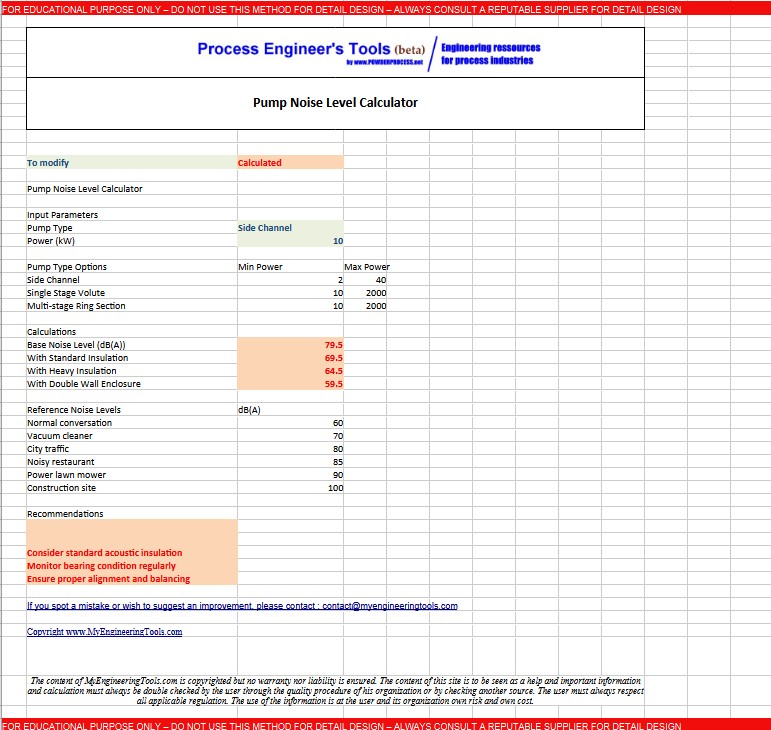
5. Pump noise estimate free calculator
Warning : this calculator is provided to illustrate the concepts mentioned in this webpage, it is not intended for detail design. It is not a commercial product, no guarantee is given on the results. Please consult a reputable designer for all detail design you may need.
5.1 Excel calculator
You can download the calculator here : link
5.2 Interactive In-Browser Calculator
Calculated Acoustic Power & Attenuation Results
- Consider standard acoustic insulation
- Monitor bearing condition regularly
- Ensure proper alignment and balancing
Frequently Asked Questions (FAQ)
1. Why are centrifugal pumps noisy?
Centrifugal pumps generate noise due to the high-speed rotation of the impeller, which creates turbulent flow and vibrations. These vibrations are transmitted through the shaft, casing, and pipes, leading to noise in the surrounding environment.
2. How can I estimate the noise level of a centrifugal pump?
Noise level can be estimated using the absorbed power and pump type. The formula varies by pump type:
- Side channel pump: \( L_{wA} = 67 + 12.5 \times \log_{10}\left(\frac{P}{P_0}\right) \)
- Single stage volute/ring section pumps: \( L_{wA} = 66 + 13.5 \times \log_{10}\left(\frac{P}{P_0}\right) \)
- Multi-stage ring section pump: \( L_{wA} = 78 + 8.5 \times \log_{10}\left(\frac{P}{P_0}\right) \)
Where \( P \) = absorbed power (kW) and \( P_0 = 1\text{ kW} \).
3. What are the main causes of pump noise?
Main causes include high flow velocities, turbulent flow, cavitation, oversized pumps, and vibrations transmitted through the pump casing and pipes.
4. How can I reduce pump noise by design?
Design strategies include accurate sizing to avoid oversizing, using low-noise fittings, mounting pumps on dampers, avoiding sudden piping changes, and using long radius bends.
5. What role does cavitation play in pump noise?
Cavitation produces a distinct noise. Ensuring the inlet pressure is above the pump’s NSPHr (Net Positive Suction Head Required) prevents cavitation and reduces noise.
6. How can insulation reduce pump noise?
Insulation methods like sound-absorbing panels or enclosures can significantly reduce noise (up to 20 dB(A)). Ensure the design allows for pump maintenance.
7. What are low-noise pump components?
Use low-noise motors, gearboxes, and vibration-reducing pipework to minimize noise generation.
8. Are there tools to calculate pump noise levels?
Yes, our website offers a free online calculator and an Excel tool to estimate pump noise levels.
9. What precautions should be taken when using the noise calculator?
The calculator provides theoretical values. Consider ambient noise, reflections, and always verify results with real-world conditions.
10. How does pump type affect noise levels?
Different pump types (e.g., side channel, single-stage, multi-stage) have varying noise levels due to their design and operating principles. The noise formula adjusts based on pump type.
Source
[Sihi] Basic Principles for the Design of Centrifugal Pumps Installations, Sterling SIHI GmbH, 2003